Florida A&M University coach Willie Simmons was pointed but restrained on Friday when I invoked the name of Deion Sanders.
This was the first time in two years, I noted, that the Southwestern Athletic Conference and the Cricket Celebration Bowl were not dominated by the aura of the former Jackson State University coach, who is now at the University of Colorado. How did it feel, I asked, to not have to coach in his shadow?
Simmons chuckled.
“I have a lot of goals I set for my life. One of the goals is that I’ll be gone from a place for a year, and they’re still talking about me,” he said. “We’re talking about Coach Prime, and he’s been gone for a year, so I want to get to that place of life where my name continues to ring even when I’m no longer there.”
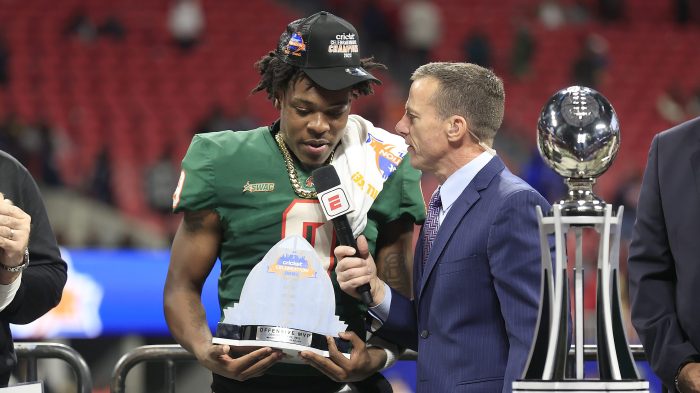
Simmons, the 2023 SWAC coach of the year, took a step closer to building that kind of legacy on Saturday when Florida A&M defeated Mid-Eastern Athletic Conference champion Howard University 30-26 to win the Celebration Bowl in front of 41,108 fans. It was Florida A&M ’s first Celebration Bowl victory and the SWAC’s second in the eight-year history of the event.
But that is not the earned legacy Simmons was referring to, and we both knew it. Simmons, who became Florida A&M’s coach in 2017, was talking about the victory of hype over substance that put Sanders front and center in the Black college football universe for three years. After dominating the SWAC in the regular season, Sanders brought two Jackson State teams to the Celebration Bowl, in 2021 and 2022, and lost the title game both times. Yet, because of the public relations buzz he created, he still has resonance.
Simmons’ point is well taken. But the reality is, in Sanders’ three-year run as Jackson State’s coach he left his fingerprints all over football at historically Black colleges and universities and especially on the Celebration Bowl. The unprecedented media hype turned Jackson State’s opponents into props and sideshows: He often sucked all of the air out of an event.
Last year North Carolina Central University coach Trei Oliver complained his team had been inconvenienced to accommodate Jackson State. A year earlier South Carolina State University coach Buddy Pough complained his team was being overshadowed by the Coach Prime circus.
In October 2022, Alabama State University coach Eddie Robinson Jr. called out Sanders after losing to Jackson State, saying he felt disrespected.
“He ain’t SWAC, I’m SWAC,” Robinson said. “He ain’t SWAC.”
Robinson played in the SWAC at Alabama State. Simmons played at Clemson University and The Citadel, and Larry Scott, Howard’s coach, played at the University of South Florida. But “being SWAC” is a metaphor for putting in the work, grinding. Simmons and Scott put in the time. Simmons coached at Alcorn State University and Prairie View A&M University before getting the Florida A&M job. Howard was Scott’s first HBCU job, but he had coached for more than 15 years beforehand.
I was curious to see how this year’s Cricket Celebration Bowl felt with a pair of fresh teams and without the bells and whistles of the Coach Prime roadshow. The atmosphere actually felt pretty good – normal, not hysterical, not driven by a cult of personality.
This Celebration Bowl was like an HBCU homecoming on steroids. Besides the sea of Florida A&M orange and green and Howard red, blue and white, there was an all-star smattering of other HBCUs as well — a Grambling State University sighting here, a Prairie View A&M sighting there and of course the collage of Greek fraternities and sororities.
While Sanders attracted national media attention — including a 60 Minutes interview – I never got the sense the media that flocked to him really understood the HBCU experience. I’m not sure he ever completely got the experience either – he didn’t stay long enough to really get it. Just before last year’s Celebration Bowl, Sanders announced he was leaving Jackson State for Colorado.
As I spoke with coaches and conference commissioners this weekend, the consensus was he had used Black college football for his personal gain, but bottom line: Black college football was and always will be.
“Deion brought a lot of cameras and a lot of shine and opened up the world to it because the cameras followed him,” Scott said. “It became a media frenzy. It became something for everyone to talk about. And it just so happened that it was attached to HBCUs. But for people who really had already embraced HBCUs, that shine has always been there.”
The presence of rappers and entertainers at games became a Coach Prime staple. The most significant celebrity at the Celebration Bowl was Vice President Kamala Harris, a Howard alumna.
The vice president’s presence sent a resounding message that in many ways is more closely aligned with the historic mission and purpose of HBCUs. These schools are not sports factories. Young Black student-athletes do not use schools such as Howard as a runway to the NFL.
Sixty years ago, Black athletes might go to HBCUs expecting to reach the pro ranks because predominantly white universities, especially in the South, were not recruiting Black athletes or students. That dynamic obviously has changed, with revenue-producing sports programs at predominantly white universities running on Black talent. The talent drain forced HBCUs to create spaces of their own, hence the Celebration Bowl, a celebration of the Black college football experience.
When we spoke on Friday, Scott talked about the purity of HBCU football, especially in this era of the transfer portal. He believes Black colleges represented a more solid academic journey.
“You look at what’s happening at PWI levels and Power 5 levels, with the transfer portal and kids playing at three different programs, doing this and that,” he said. “We’re all used to and accustomed to seeing young people develop and grow through the program, commit themselves to the process and doing all those types of things instead of running and dodging and looking.”
That’s not entirely accurate. HBCU programs still must operate in the modern reality of college football, and the portal is a major part of that reality. Most of Howard’s players were recruited out of high school. A significant number of Florida A&M players used the transfer portal to get to the university. For example, star Rattlers quarterback Jeremy Moussa played at three schools before landing at Florida A&M.
SWAC commissioner Charles McClelland acknowledged what Sanders did for Black college football during his three-year run at Jackson State but was clear that the conference specifically and Black college football in general thrived before Sanders – and will thrive long after.
“Prime gave an extra level of eyes upon this game,” McClelland said. “But it has always been one of the highest-watched games of the pre-New Year’s bowls.”
That was true before Sanders and will be true this year, he added.
“We’re very appreciative of the additional hype and additional eyes that were put on the game by Coach Prime, but attendance is not down this year and viewership won’t be down.
“Coach Prime brought a lot, but the Southwestern Athletic Conference has been popular prior to, and we will be popular post-Coach Prime. So, whether it’s Deion Sanders or whether it’s put the name in there, we’re going to continue to do the things that have kept the Southwestern Athletic Conference around for 102 years.”
Simmons offered one final thought about the Coach Prime effect on HBCU football.
“We’re thankful for the spotlight that has been placed on the SWAC and HBCU football, largely as a result of what Coach Prime was able to do at Jackson,” he said. “We want to continue that narrative. We wanted to keep it going. You know, we don’t want to be a one-trick pony where it’s tied to one person.”
But ultimately, the success and prosperity of HBCUs – and in this case, HBCU football – is not about one personality and never has been, Simmons said.
“This thing is so much bigger than one individual. It’s so much bigger than one school. As HBCUs we’re all in this thing together,” he said. “So, we continue to uplift that brand, continue to uplift our conferences. We all have to put our best foot forward every single day.”
Simmons said he wants his name to echo across generations. He took a big step in that direction in Atlanta on Saturday.
Leave a Reply