Comedian Katt Williams showed up on former NFL star Shannon Sharpe’s Club Shay Shay podcast and spent almost three hours airing out his grievances about everyone from Steve Harvey and Cedric the Entertainer to nearly every comedian whom he’s ever felt disrespected him. Soon after the podcast’s release, clips of Sharpe and Williams’ conversation went viral, and it felt like less of an interview and more like an impromptu standup special.
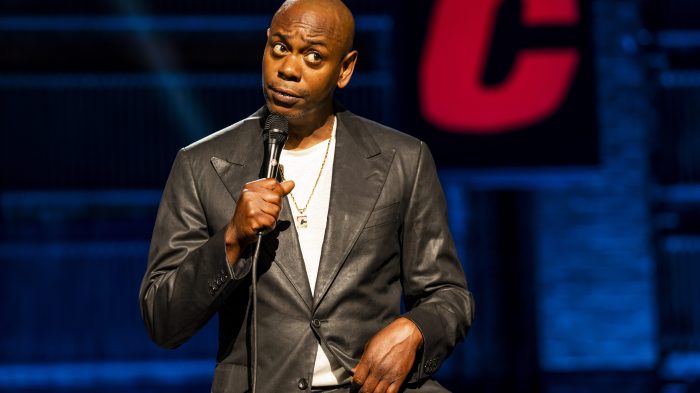
The episode — which has racked up more than 15 million views in just over a day — coincidentally came out in the same week as Dave Chappelle’s latest Netflix special, The Dreamer. Both men know how to dominate news cycles and court controversy. The difference is that while Chappelle declares himself a dangerous comedian who pushes the envelope, he punches down at the most vulnerable among us. However, Williams reminds us that actual dangerous comedians punch at those either on their societal level or above.
From the moment Williams was introduced on Sharpe’s podcast, it was clear he was ready to unload. He accused Cedric the Entertainer of stealing jokes. He clowned Harvey for supposedly wearing a hairpiece through the 1990s and cribbing the concept for The Steve Harvey Show from comedian Mark Curry’s Hangin’ With Mr. Cooper. He bashed Faizon Love for being someone who can’t get a comedy special. He claimed rapper Ludacris sold out to the Illuminati. Williams did all this with his usual bluster, adept storytelling, and laugh-out-loud retorts.
The Friday After Next star also saved some of his most pointed barbs at those whose mainstream success far exceeds his and who wield more power than he does. Williams critiqued Sean “Diddy” Combs, a near-billionaire who has recently been accused of abuse and sexual assault by multiple women (“‘Cause P. Diddy be wanting to party, and you got to tell him no,” Williams said). While plenty of male celebrities have alluded to Combs’ rumored behavior in the past, Williams is one of the few high-profile male celebrities to go after him since the allegations came out. He also accused Harvey Weinstein, former film producer and convicted sex offender, of sexually harassing him. And Williams claimed that he had a plot point removed from Friday After Next because it involved sexual assault as a punch line.
Comedy is at its most dangerous and groundbreaking when the jokesters aim upward at the most powerful. Hannibal Buress risked his career in 2014 to remind the world that Bill Cosby had been accused of sexual assault on multiple occasions. George Carlin’s “seven dirty words” routine in 1977 challenged the TV industry by pointing out the hypocrisy of banning certain curse words. Mae Martin called out anti-trans comedians by name in their special, SAP, which airs right next to the same men Martin blasts for their anti-trans content — a move that had to have them worried about their special getting outright canned. Queer comic Sophie Duker also called out her peers who punch down at Black and queer folks. Williams even bashed singer Michael Jackson 20 years ago for Jackson’s abuse allegations while the singer was still alive. These types of jokes shift the culture, but they can also damage careers.
But this is what it truly means to be a “dangerous” comic. In a world where comedians are complaining about cancel culture, pouting at the notion that they can’t say whatever they want without falling victim to some amorphous and fictitious idea of “cancellation,” Williams is doling out unfiltered rawness at anyone he deems worthy.
Which brings me to Chappelle.

Lester Cohen/Netflix
With each new comedy special, including The Dreamer, Chappelle is increasingly concerned about the notion that he’s going to get canceled or face repercussions for his jokes about the trans community. He maintains that the LGBTQ community is so powerful and organized that they will make his life hell and damage his career. The irony here, of course, is that he’s saying this on his seventh multimillion-dollar Netflix special. Chappelle’s jokes about the trans community — including his opener on The Dreamer about how witnessing Jim Carrey’s method acting as Andy Kaufman was like being around a trans person and asking to respect their pronouns — are increasingly hackneyed and lazy and done as much out of animus as for some desire to prove he can be as mean an edgy as possible. But Chappelle’s routine is not edgy for a couple of reasons. One, there’s nothing dangerous about picking on a community with no real institutional power to fight back. Two, it’s very unoriginal. So many comedians of Chappelle’s stature — Rogan, for example — complain about censorship concerning their desire to bully queer folks. Chappelle isn’t even the only comedian with a Netflix special out this week to make those complaints, as once-respected comedian Ricky Gervais spent much of his latest stand-up special doing the same.
Chappelle’s schtick is not cutting-edge or dangerous, largely because his targets can’t do anything to him. Even when he turned his attention to former U.S. Rep. Madison Cawthorn, who once complained that his Black political opponent was trying to “ruin white males,” Chappelle focused on the fact the politician uses a wheelchair as part of a series of jokes about disabled people. Instead of commenting on Cawthorn’s actual politics, the former congressman became an avatar for punching down at disabled people. To further the safe space Chappelle provided for Cawthorn, the two snap pictures together and hang out during the closing credits of the special. It doesn’t get any safer than grinning alongside someone who tried to weaponize racism to win public office, but Chappelle is now the same person who tours with Rogan and invites Tesla founder Elon Musk on stage. These are the people he creates space for while alienating actual marginalized communities.
For his part, Williams has always touted Chappelle’s talent, previously calling him the greatest of all time and speaking fondly of him to Sharpe. But you can’t hear Williams’ comments about so-called cancel culture and adapting to the times without thinking of Chappelle. “That’s how it is in the world,” Williams explained. “There are words we can use for a while until someone says ‘That ain’t a good word … That don’t make people feel good.’ And we stop saying the word … There are things you can say to get your point that don’t have to hurt people.”
Throughout his career and the interview, Williams displayed an understanding of what it means for his comedy to be a safe space for Black women and queer folks. In discussing his 2018 viral back-and-forth with radio host Wanda Smith, Williams explained how her insinuating he was gay as an insult was actually an insult to the queer community. He also talked about the fine line he had to walk when joking about a Black woman and her weight, instead focusing on Smith’s “gnarled fingers” (though, to be fair, he did talk about her weight at the time). One of the most poignant moments from the interview came when Williams talked about actor Taraji P. Henson and her recent comments about the pay gap for Black actors in Hollywood, empathizing with her and pleading with others to stand with her. “When our people call out for help, we have to understand,” he said.
This isn’t to say that Williams’ three-hour diatribe is perfect. The man claimed he could still run a 4.1 second 40-yard-dash at 52 years old. He also said he read 3,000 books a year from ages 8 to 12. And it’s hard to imagine that Williams could require comedian Rickey Smiley to wear a dress as part of his contract, but he claimed that’s how it went down in the film First Sunday. And so on. His comments about Eudoxie Bridges, Ludacris’ wife, and her appearance were out-of-bounds as well.
Overall, though, Williams gave us a master class of what it means to be a comedian who pushes the envelope and shakes the table. As a result, his three hours have cracked open the internet, eclipsing the social media discourse that a Chappelle special used to be able to command. Instead, the safe, tiresome, played-out Chappelle gimmick is losing relevance with each trans joke.
Meanwhile, Williams will remain a beloved figure for fans as long as he sticks to his formula of aiming his fire at the people who have the power to fight back.
Leave a Reply