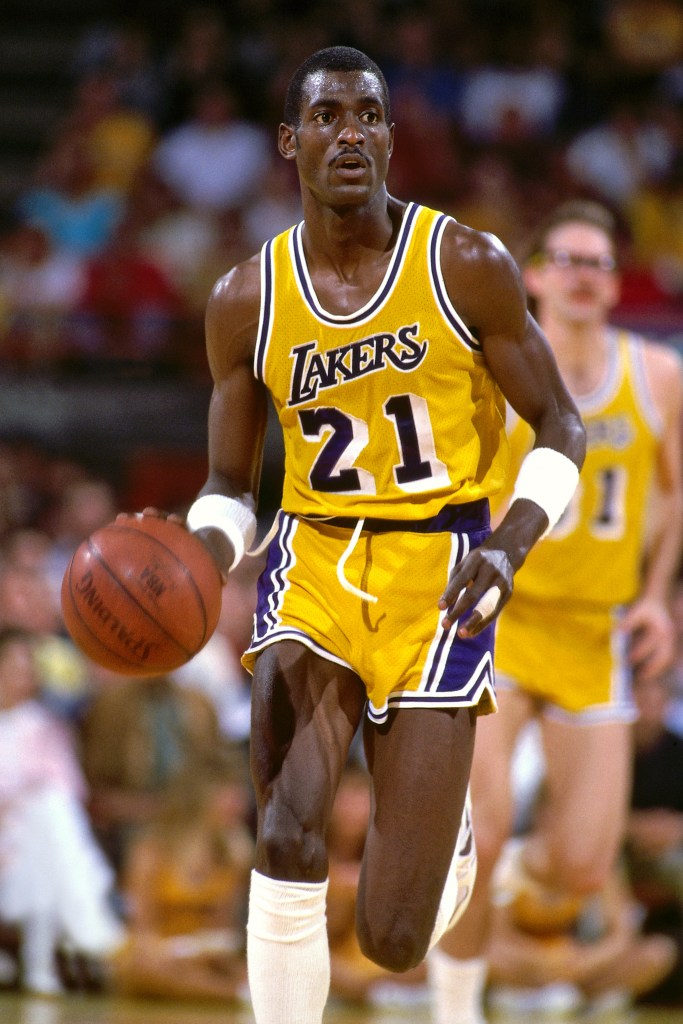
Then-Los Angeles Lakers head coach Jerry West took unheralded rookie Michael Cooper to the side in 1978 before that season’s first practice and told him to pay attention to the elite scorers. The roster included Kareem Abdul-Jabbar, Norm Nixon, Jamal Wilkens, Adrian Dantley and Lou Hudson. West told him it was in his best interest to concentrate on defense.
“I’m heading to training camp. I get to Loyola Marymount,” Cooper, 68, said. “And when I walk into the gym I see Kareem Abdul-Jabbar and Jamaal Wilkes and Norm Nixon. So, we get into practice and stuff. Jerry pulls me to the side and he goes, ‘Coop, I already have scorers. I got 30 points in Kareem. I got 27 to 28 from Jamaal Wilkes. I got 22 to 25 in Norm Nixon. There is not enough balls to go around for you to get shots. So, I need somebody to play defense.’
“So, I said, ‘Hey, I already got the fundamentals down. I got the aggressiveness down.’ And now I’ve been told that this was going to be my role. So, I took that to heart, embraced it, got better and better.”
Cooper used West’s recommendation to not only solidify his role with the Lakers but also become one of the NBA’s greatest defenders, one who has made his way into the Basketball Hall of Fame.
The defensive-minded swingman averaged 8.9 points, 4.2 assists, 3.2 rebounds and 1.2 steals while playing all 12 NBA seasons with the Lakers. The 1987 NBA Defensive Player of the Year was an All-NBA Defensive Team selection eight times, including five times as a first-team selection. Cooper was also the co-winner of the 1985 NBA J. Walter Kennedy Citizenship Award presented annually by the Pro Basketball Writers Association to a player, coach or athletic trainer who shows outstanding service and dedication to the community. The former University of New Mexico star was named a 1978 first-team All-American by the United States Basketball Writers Association.

Andrew D. Bernstein/NBAE via Getty Images
Cooper will be inducted into the Hall on Sunday in Springfield, Massachusetts. The Pasadena, California, native learned that he made the Hall of Fame on April Fools’ Day after receiving a phone call from Hall of Fame CEO John Doleva and board chairman Jerry Colangelo.
“I’ve always played this game for the love of the game. And after 12 years, the accolades that come with it, I never, ever, ever thought that my footsteps would be standing at the door of the Hall of Fame,” Cooper said. “So, I knew the call was going to be coming, and it came at about 9:10 that morning. I had been on the ballot two years, and I got that call [previously], and I’m waiting, and I was really excited. And [in prior years] they said, ‘Hey, Coop … it’s not your year.’
“So, when [this] call came, I remember answering the phone, and my wife was sitting next to me and I had it on speakerphone. And I kind of like spazzed out for a minute, and they were going like, ‘Coop. Congratulations, you got in.’ I’m sitting there holding the phone and my wife [hit] me on the leg, she said, ‘Babe, you got in.’ And I’m like, ‘If this is an April Fools’ joke, this is very, very rude, you guys.’ Mr. Colangelo starts laughing and he goes, ‘No, no, Coop, you got in.’ ”
Cooper is one of 14 Hall of Famers who averaged fewer than 10 points. That list includes defensive standouts such as Dennis Rodman, Ben Wallace and Dikembe Mutombo. The most points Cooper ever averaged was 11.9 points during the 1981-82 season. Unlike Rodman, Wallace and Mutombo, however, Cooper was never an NBA All-Star.
When asked what makes him a Hall of Famer, Cooper said, “I kind of liken myself to a Bobby Jones or a Ben Wallace or Dennis Rodman. When you think Hall of Famer, you think of somebody that averaged 28 to 30 points, a guy who was a 15-time All-Star, six- or seven-time All-NBA. And you know what the Hall of Fame is about, your body of work for sure on the court.
“But the other thing that I found out [about] the Hall of Fame is what have you done for the game of basketball. What have you given back? So, it’s outside the game, too. So, you know what, when you stack up everything like that, my body of work is just as good as anybody that’s in.”

Dick Raphael/NBAE via Getty Images
While playing with Magic Johnson and The Showtime Lakers, Cooper created a stellar presence by always taking the toughest defensive assignment. Boston Celtics legend Larry Bird once said the slender 6-foot-7 guard was the greatest defender he ever faced. With Bird and other elite NBA scorers Cooper defended well in mind, former Lakers teammate Byron Scott said he was always inspired by Cooper’s smothering defense, unselfishness and winning attitude.
Scott added that it’s “so long overdue” that Cooper made the Hall of Fame.
“He was one of the best defensive players to ever play the game,” Scott said. “Even Larry Bird has been saying that for years, how great a defensive player he was. And then there is fact that it was all about winning with Coop and it was never about the individual accolades. So, to see my brother get in, man, I was so excited and happy for him.
“I saw how hard he worked and I tried to emulate him on the defensive end as much as possible. I saw his greatness every day. I saw him guard Magic, James and myself in practice. I just saw his intensity. I saw his toughness, his determination on that end of the floor and the pride that he had. He had just so much pride of going out every single night and taking an assignment to shut somebody down. And he did it with such grace and humility that it was just fun to watch.”
Cooper said he respects guards Michael Jordan and George Gervin, and that Bird was the hardest to guard for several reasons.
“Well, with Larry, when he passed the ball, he was going to go off to rebound,” Cooper said. “He was going to set a back pit. He was going to do something to affect the game, so you never could really rest against him on that end. And that’s why I say that man was very difficult to guard …
“But Larry was a phenomenal player as well as the other players I’ve talked about, and many players in the NBA. But he was the one that you always had to stay attentive to. You had to stay in the game with him all the time.”
What was also inspiring about Cooper was that he became a Lakers legend without being a high draft selection.
Cooper was drafted with the 60th overall pick in the third round of the 1978 NBA draft by the Lakers, compared to the current NBA draft with 60 overall selections. Cooper is seventh all-time in games played with the Lakers and played in more than 80 games in nine of his 12 NBA seasons. The only other pro basketball franchise that he played for was the Italian team Pallacanestro Virtus Roma during the 1990-91 season.
“His determination, his grit, his pride being home, I think helped,” Scott said. “Just the fact that he was being able to play for a team that he admired. An organization that he loved and getting that opportunity to play in front of friends and family. Sometimes it’s a blessing in disguise when you don’t get drafted in the first round or a lottery pick because it makes you work harder. And that’s what it did with Coop. It just made him more determined to be a factor in the NBA.”
Cooper also made an impact as a basketball coach for NBA, WNBA, college and high school teams. He was an interim head coach with the Denver Nuggets during the 2004-05 season, an assistant coach with Nuggets and Lakers and a coach with the Albuquerque Thunderbirds in the G League.
The 2000 WNBA Coach of the Year led the Los Angeles Sparks to back-to-back championships in 2001 and 2002 with Hall of Famer Lisa Leslie, and also coached the Atlanta Dream. The former USC women’s basketball head coach also has coached in the Big3, Los Angeles-area high schools and is an assistant coach for the men’s basketball team at Cal State Los Angeles.

Andrew D. Bernstein/NBAE via Getty Images
“When I got involved with that coaching I tried to take some of the things that [my former Lakers coach] Pat Riley was teaching us with. And the biggest one was attention to detail. So, when I got to the Sparks, I was trying to implement that or give that to the women, and I had probably one of the greatest players that’s ever played this game on the female side, and that’s Lisa Leslie,” Cooper said.
After Cooper was named a Hall of Famer, the Lakers announced they will retire his No. 21 jersey. The ceremony will take place Jan. 13, 2025, when the Lakers host the San Antonio Spurs at Crypto.com Arena. Cooper joins former Lakers stars Wilkes, West, Abdul-Jabbar, Johnson, Kobe Bryant, Wilt Chamberlain, Pau Gasol, Elgin Baylor, Gail Goodrich, Shaquille O’Neal, James Worthy and George Mikan and NBA icon Bill Russell players whose jersey numbers have been retired by the franchise. Cooper said West once told him that you have to have at least been a former All-Star and All-NBA player to get your jersey retired with the Lakers.
So, what means more to Cooper? Going into the Hall of Fame or the Lakers retiring his jersey?
“I’m a very emotional guy, and I really try not to show it,” Cooper said. “But the Hall of Fame, I’m going to cry because there’s some people I’m going to mention. But when I sit there and they asked me to pull that rope, and I can finally see No. 21 up there in the rafters with everybody else, it’s going to be a moment because, if you know, dying is part of living. And one day we’re all going to leave this earth.
“But the one thing that I get the opportunity to leave for my grandkids, my great grandkids — even with the advancement of these arenas changing, and pretty soon the Lakers will have to get a bigger place and all that — but you know what, whenever they change this arena, they have to put that jersey up there. And my grandkids will be able to say, ‘You know what, that’s my grandfather up there.’ ”
Leave a Reply