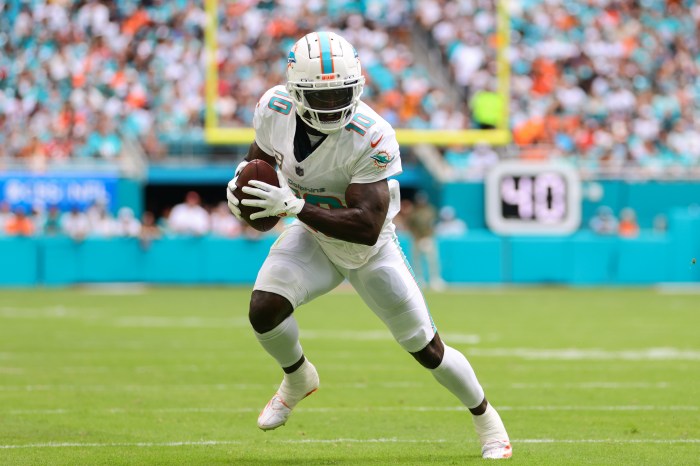
Finally, we have an agreement for The Race.
Sandwiched between the beginning of March Madness and the unfolding NBA season, a grudge match between Olympic gold medalist Noah Lyles and Miami Dolphins star wide receiver Tyreek Hill has begun to take shape. After months of social media trash talk, Lyles, 27, and Hill, 31, apparently have agreed to meet for a match race to determine who is the unofficial speed King of the Hill.
Lyles and Hill told People Magazine last week that they will compete in a 60-yard race sometime this spring or summer.
“Time to shut your mouth and take your lunch money,” Hill said in a post, adding later “Track world about to be in shambles.”
I’m not sure that shambles is the right word, but a victory by Hill would certainly be an embarrassment to a sprinting community which believes that fast football players are merely playing at speed. Lyles won the 100-meter gold medal at the Paris Olympics; Hill, known as the Cheetah for his football speed, won a Super Bowl ring with the Kansas City Chiefs.
I have my doubts that the match race will ever take place.

Sam Navarro-Imagn Images
Will the Dolphins allow Hill to risk injury by racing Lyles? And Lyles is focused on defending his 100- and 200-meter world titles at the World Championships in Tokyo this September. First, he has to make the team, and the USA Track & Field nationals are in Eugene, Oregon, from July 31 to Aug. 2. Hill will only have time to race in late April, early May and in mid-June to mid-July.
Still, I’m intrigued by the outside possibility that for the first time in more than 60 years, the World’s Fastest Human could be an NFL player.
Bullet Bob Hayes won the 100 meters gold medal at the 1964 Tokyo Olympics. Running in borrowed shoes, Hayes set an Olympic record, covering the course in 10 seconds flat. Six days later, Hayes followed up his record setting performance by running a spectacular anchor leg in the 4×100 relay to catapult the United States to a gold medal (he overtook half the field and ran an anchor leg estimated to be 8.6 seconds).
Immediately after the Olympics, Hayes, announced that he was retiring from track to pursue a career in the NFL. The Dallas Cowboys selected Hayes in the seventh round of the 1964 draft. Hayes forced NFL teams to change the way they played defense and established himself as one of the greatest deep threats of his era.
Hill is the latest in a line of speedy NFL wide receivers, but he is no Hayes. For that matter, neither is Lyles.
I filter Hayes through the prism of time and generation. He was part of an era when most great Black athletes attended Historically Black Colleges and Universities. Hayes played for legendary football coach Jake Gaither at Florida A&M University. He would become the first NFL player to win a gold medal and a Super Bowl ring and was inducted into the Pro Football Hall of Fame in 2009.
This was also the beginning of an era of awakening for Black athletes. The February before the Tokyo Olympics, a brash 22-year-old boxer named Cassius Clay (who would change his name to Muhammad Ali) upset Sonny Liston to become heavyweight champion of the world.
The world would never again see an athlete like Ali. The NFL has never again seen an Olympic speed merchant like Hayes. Track and field has not seen a football player like Hayes, who Gaither famously described as “A football player who just happened to be the world’s fastest human.”
In any event, I’m eager to see Lyles and Hill race for sheer entertainment value and also to drive home the point that football speed and track speed exist on entirely different planets.

AP Photo/Petr David Josek, File
Hill ran track collegiately but hasn’t posted any results since 2014 when he was at Oklahoma State. That year, his best result at 60 yards was 6.64 indoors. He ran a 10.19 in the 100 and 20.14 in the 200 in 2012 when he won the 200-meter bronze medal at the World Junior Championships.
“I think he’s a great football athlete,” said Tevin Hester the assistant coach for short sprints at Clemson. Hester coached sprinters at the University of Pittsburgh and spent time on the professional track circuit. He was a four-year sprinter at Clemson. “But it’s a significant difference when it comes to linear straight-line speed, and football speed. I wouldn’t even call it speed in most cases. I would call it quickness.
“When I think track, I think of speed or fast. When I think football, I think quickness, being able to get side to side pretty fast. Track and field is just straight line. Can I get from Point A to Point B fast? It has nothing to do with the side-to-side motion. In football you have to cut up field, and you have to avoid defenders. It’s just a different approach. Some of the football athletes could be great track athletes, but, once you switch a focus to a specific sport, it obviously has to cater to the sport you’re getting paid to play.”
A large part of the preliminary discussion was determining the length of the race. Lyles boasted that if he were to race Hill at 100 meters, the race would not be competitive. “I mean if it was 100 meters, it’d be a blowout,” Lyles said in a post. “You know, we gotta meet in the middle.”
Hester agreed. “Football guys are able to accelerate because they practice for the combine, so they’re able to push, and cover ground, and accelerate in the early stages of runs,” he said. “But the longer the run goes, the worse it usually gets.”
He feels the sweet spot for the race would be 50 meters. “I believe the distance should be right in the middle.,” he said. “Obviously, Tyreek Hill runs the 40-yard dash, and Noah Lyles is the world champion at 60 meters and Olympic champion at 100 meters. But I think maybe 50 meters would be a fair distance for both of them. It would allow Tyreek to not fatigue from a speed-endurance aspect. For Lyles, being that his strength is top-end speed, and speed endurance, [the distance] will allow him to get up to speed and see who’s the best of the best.”

Kevin Sabitus/Getty Images
If they ever do race, I’ll wager that Lyles will eat the Cheetah for breakfast. Hester doesn’t think the race will be competitive.
“No, I don’t, not at all,” he said. “Noah Lyles just won the indoor 60-meter championship, I want to say last year or two years ago, and he ran 6.43. That’s just at his best. Tyreek Hill at his best, which was over a decade ago, ran 6.64, and that was when he was running track.
“I think it would be very tough for him to beat Noah. He doesn’t have the top-end speed. He doesn’t have the speed endurance. I just think he would be in for a long but short day if that makes sense.”
It’s unlikely that the World’s Fastest Human will ever again be an NFL player. But if Hill and Lyles ever do race, the winner will be track and field.
There are a number of track meets throughout the year but they’re difficult to find.
“Not a lot of people know how to tune into those events,” Hester said. “We know that the NFL is going to be on FOX every Sunday. We know where to find those events. But it’s a struggle to find track and field events because they’re on a ton of different streaming services, and it’s hard to keep up with the different athletes.”
We know Noah Lyles and we know Tyreek Hill. All they have to do is finally find the track.
Leave a Reply