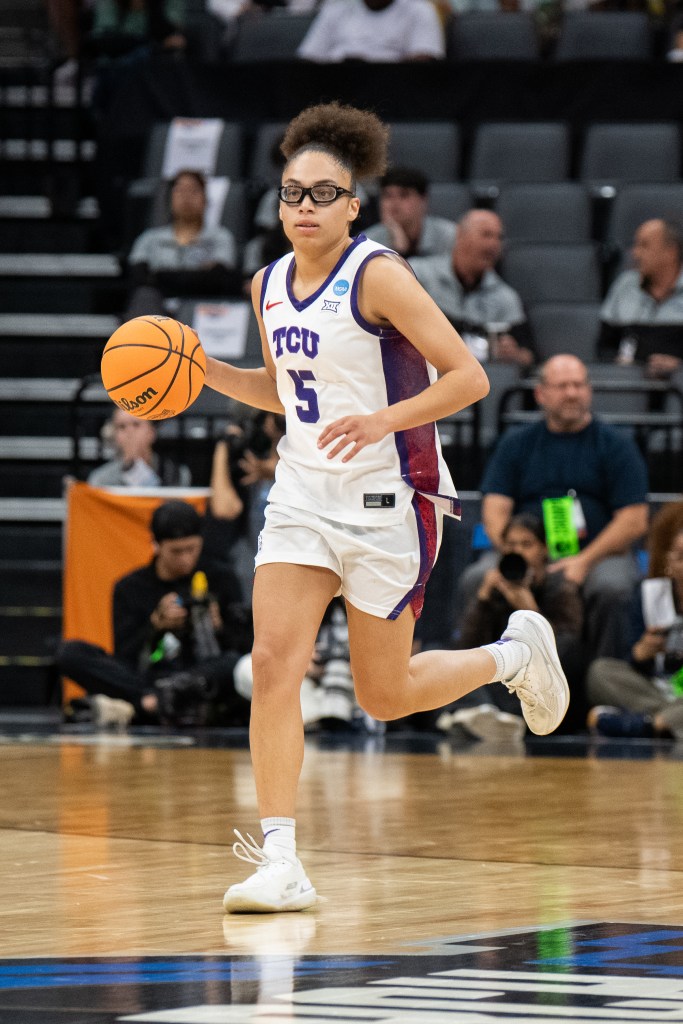
SACRAMENTO, Calif. – Shortly after her magnificent 28-point, 10-rebound, seven-assist performance catapulted TCU past Virginia on Saturday, senior guard Olivia Miles faced the media and breathed a sigh of relief.
Finally, she’d gotten at least one monkey off her back. In three stellar seasons at Notre Dame, Miles had never reached an NCAA tournament regional final. Then in April 2025, Miles leaped through the transfer portal.
Tonight, she and her TCU teammates will face South Carolina for the right to reach the women’s Final Four (9 p.m. ET, ESPN)
“Happy about that,” Miles said. “That’s just another bonus as to what I wanted to do here. Ultimately, I wanted to find my joy back.”
Miles is yet another example of how college athletes, free to transfer without limits since 2024, are making the best of transfer rules. But the emancipation legislation has also thrown a wrench into a system that for decades controlled and often exploited athletes. Now some leave – once, twice, even three times or more – until they find the right fit and the best name, image and likeness (NIL) deal.
Educators and even some coaches are concerned that the opened-ended movement will have a negative impact, not just on graduation rates but on the primary mission of earning a college degree. That sounds naïve in the current climate, when pursuit of a degree seems to have been overshadowed by the pursuit of the dollar.
On Sunday, South Carolina coach Dawn Staley said the transfer portal and NIL have become intertwined. In her playing days at Virginia, a coach would promise parents that they’d make sure their son or daughter earned a college degree.
Now?
“How much is it going to cost us?” Staley said. “That’s the conversation you got to lead with because you don’t really want to waste your time. Like, you either are going to have enough to pay players or you don’t, and you move on. Because you know, although you can promise a young person this or that, if your budget says otherwise, I don’t like to promise anything that isn’t available to us. I don’t want to have to go out and get the money because you can be told no, and then your back is against the wall.
“So, you have to lead – I won’t say I lead with that question, but I get to it fairly quickly so you’re not wasting your time and spinning your wheels on somebody that you can’t afford.”

Supriya Limaye/ISI Photos/ISI Photos via Getty Images
The system has worked for Miles, who combined pursuit of a degree at Notre Dame with the pursuit of a more joyful playing environment at TCU.
Miles earned a bachelor’s and master’s at Notre Dame before transferring to TCU, but the concern among educators is that the combination of unlimited transfers and NIL deals have relegated the pursuit of a degree to background music.
The Division I women’s basketball transfer portal opens April 6; the Division I men’s basketball transfer portal opens April 7. The lines to jump in is already wrapped around the block.
“The freedom of movement is great for the student-athletes from an athletic competition standpoint,” said Carla Williams, athletic director at the University of Virginia. “We don’t know the implications academically yet, but it is something that I do think about, and my hope is that the academic mission of our institutions won’t diminish because of the freedom of movement.”
Ed Scott, the athletic director at the University of Memphis, is certain that the movement will have a negative impact on graduation rates.
“I think ultimately it has to because the rate of movement by student-athletes now is, just by default, going to cause less people to graduate.”
Scott has useful insight into the evolution that has led intercollegiate athletics to yet another intriguing crossroads.
Scott was the athletic director at Morgan State, an historically Black college and university (HBCU) in Baltimore. He then served as associate athletic director at the University of Virginia before assuming his current position at Memphis. Scott was also an accomplished baseball player at the University at Albany (N.Y.), and it was that experience that has allowed him to understand the mindset of current college athletes.
Scott said if he were beginning his college career in the current climate, his 20-year-old self would likely be in the portal negotiating an NIL deal for himself. Scott was an above-average college baseball player. Had he been a student-athlete in the current climate, he may not have been long for Albany if a top-tier program had come calling.
“The reason I went to college in the first place was to try to become a professional baseball player and take care of my family, and if I couldn’t do it through baseball, I wanted to make sure I got an education,” Scott said during a recent interview. “If I’m being honest, if somebody offered me back then a couple hundred thousand as a baseball player because that was the market, or $300,000 or $400,000 – like, ‘Hey man, we want you to transfer to our school?’ – my No. 1 priority in life has been taking care of my mother, so I absolutely would have done that.
“It’s unfortunate that I would have been put in that position to make that choice because the rules are the way they are. I would have used the system to the best of my ability to provide for me and my mother.”

Ed Szczepanski-Imagn Images
Mentorship ultimately change the trajectory of Scott’s career, and staying in one place allowed him to build a career-altering relationship.
“What happened to me at Albany was I learned I could compete in the academic arena the same way I could athletically,” Scott said. “So, I started to realize how important education was for me. And then I met Dr. Lee McElroy.”
McElroy joined Albany in 2000 as athletic director. At the time, he was one of only 12 African American athletic directors in Division I.
“Early in my career as a baseball player at Albany, he was probably the first African American male that I saw as a role model that wasn’t a coach or a professional athlete,” Scott said. “He showed me that access and opportunity was possible.
Scott earned his bachelor’s and master’s degrees from Albany, and his PhD from Binghamton University’s School of Community and Public Affairs
“It’s because of that man that I said, ‘Wait, there’s another path besides being a college baseball player. I can do what he does, still be around sports and help people achieve their goals and dreams while getting an education.’ And so, because of that, I became an athletic director.”
Had Scott transferred, he likely would not have established a relationship with McElroy, certainly not had he transferred multiple times.
“It’s much harder now to build the relationships with student-athletes,” Scott said.” I’m a first-generation college graduate with a PhD, and it’s because of guys like him that actually took time to build a relationship. Today it’s harder because of the transfer rules. Much harder.”
Some programs do not focus heavily on recruiting players who are likely to transfer, preferring to go after lower-profile players who are likely to stay and be developed.
Purdue men’s basketball head coach Matt Painter said he has had one McDonald’s All-American in his 21 years as head coach. He said four of Purdue’s starting five players did not have a high Division I scholarship offer.
“So, we’ve got guys who come to work,” Painter said. “Some programs have been better at recruiting. We’ve been better at evaluating.”

Ryan M. Kelly/Getty Images
Intercollegiate athletics has suffered a major shock to its system. Athletes transferring is nothing new. What’s new is the overwhelming number of transfers. There will likely be a similar shock to the NCAA’s system a few years from now when federal graduation rates, beginning with the incoming freshman class of 2024, are assessed.
“The biggest thing that has changed for compliance and academic support is the volume,” Scott said.
He said Memphis added more than 50 football players before the start of spring semester. “So, volume is the issue. It’s not the process, it’s the volume,” Scott said. “Just by default with the system changing, the number of people changing school to school has grown 10 times.”
This is the golden age — or perhaps a golden moment — for college athletes. They can change programs without restriction and can often negotiate lucrative NIL for themselves. On the other hand, the freedom college athletes currently enjoy can be detrimental to their academic health if not properly monitored. What’s difficult to determine is whether the degree is as cherished by athletes as it once was, or whether the hype around NIL makes it seem like the importance of a degree has faded.
A player like Miles effectively negotiated the United States’ unique scholarship system, which offers an education in exchange for athletic skill. Miles earned two degrees from a prominent university, then changed schools to reclaim her joy in playing the sport she loves.
“It all depends on what your motive is,” Scott said. “My motive to go to college was to take care of my family, so that’s why I said I would have chased the money. Not every kid wants to go pro or thinks they can. Some kids want to play, and they want to get their education. It depends on what the student-athlete’s priorities are. That will dictate how they move.”
Only time will tell if the glut of athletes flocking to the portal will use the system or be used.
I’m not optimistic and neither is Scott. The priorities seem to be skewed.
“The current state we’re in, many student-athletes de-emphasize the degree and overemphasize the money, the limelight,” Scott said. “I think that student-athletes are making decisions that are much less about education and more about playing time.”
Having freedom is one thing; learning how to use it is quite another.
The post In NCAA athletics, student-athletes are often choosing deal over degree appeared first on Andscape.
Leave a Reply