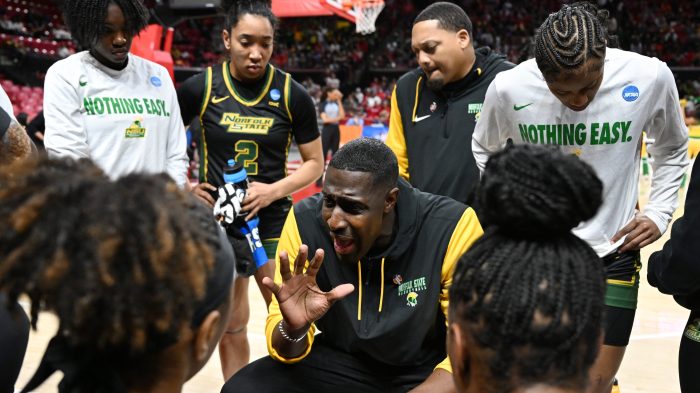
During Larry Vickers’ final game as Norfolk State’s women’s basketball head coach, the Spartans’ NCAA tournament matchup against Maryland on Saturday, all he wanted was for his team to get some respect.
Norfolk State entered the NCAA tournament as a No. 13 seed – the highest seed earned by a team from a historically Black college or university in the last decade – with a 19-game win streak and three consecutive tournament appearances. Yet Vickers felt his Spartans didn’t receive the respect their résumé warranted.
“This group won 30 games this year, 27 games last year, 26 games the year before, and we still walk into these things having to get respect from the three people [officials] on the floor,” Vickers said after the Spartans’ 82-69 loss in the opening round. “I’m not going to complain about officiating. … But when y’all see these Spartan heads in your gym, I think we should get a little bit more respect than we get.”
For HBCU teams in the NCAA tournament, that sentiment isn’t new. Coaches like Vickers have raised objections over frequently being relegated to a No. 16 seed and left out of other postseason tournaments if they don’t win their conference championships. Many HBCU women’s basketball coaches and players believe that due to their programs’ increasing levels of talent, competitive conference play and regular-season wins over Power 4 programs, they deserve more respect in the women’s college basketball landscape.
Graduate student Niya Fields, who played in all three of Norfolk State’s most recent NCAA tournament appearances, said the Spartans’ mindset shifted from being happy they made the tournament to coming in hungry to win.
“As an HBCU player and just a team as a whole, coming to games like this you have to come in 10 times harder than you played before. … As much as people say, ‘The target’s not on your back,’ it is because they’re not expecting us to win,” Fields said. “They’re already coming to the games, like, ‘Oh, an HBCU, you know, this is an easy one,’ but no, not us. Like, we’re coming in to fight. We’re coming in for our respect.”
Southern, the Southwestern Athletic Conference (SWAC) tournament champion, received a No. 16 seed in the NCAA tournament. The Jaguars’ 68-56 victory over UC San Diego in the First Four secured the first ever revenue share units for a SWAC women’s basketball team in the inaugural year of the women’s basketball tournament giving financial payouts.
“I think a lot of people underestimate HBCUs,” said Southern senior Aniya Gourdine after the Jaguars’ 84-46 first-round loss to UCLA on Friday. “They don’t really believe we belong here. I think it was huge for us to go and get that big win, which is why we wanted the UCLA game so bad. It’s huge for HBCUs. I think we shined the light; Norfolk State [is] shining the light.”
Over the last four seasons, Howard and Southern have both won First Four play-in games, but an HBCU hasn’t made it to the second round of the NCAA tournament since 1984 when Cheyney State went to the women’s Final Four.
Jackson State flirted with a first-round win in the 2022 NCAA tournament before ultimately losing to LSU 83-77. Then head coach Tomekia Reed, who is currently head coach at Charlotte, believes HBCU women’s teams have gotten closer to earning a first-round victory in recent years.
“HBCUs are making their run because they can see that it’s been done before. Our game vs. LSU and so many other close games and P4 wins in regular season is showing that anything is possible if you believe,” Reed said. “HBCU players’ stories and why’s are different. Everyone at that level – players, coaches and administrators – want to be respected for competing with less and acknowledged for their hard work.”
Vickers and Reed attribute the elevation of HBCU women’s basketball in part to the transfer portal allowing schools to attract high-level talent. Many HBCUs in both the SWAC and Mid-Eastern Athletic Conference have at least one transfer portal player with high mid-major experience on their rosters.
Vickers signed former five-star recruit Diamond Johnson, who previously played at Rutgers and NC State. While at Jackson State, Reed was able to sign former five-star recruit Daphane White. While coaching at Arkansas Pine-Bluff, current Alabama A&M head coach Dawn Thornton signed former five-star recruit Zaay Green, who transferred to Alabama this season.
“HBCUs changed their landscape of recruiting,” Reed said. “They are no longer recruiting to be conference champions. They are now recruiting to be great outside of conference play as well. … The transfer portal has also helped tremendously by evening the playing fields and allowing many to see the culture and the opportunities.”
Jackson State has had two players selected in the WNBA draft over the last four years, Ameshya Williams-Holliday (25th overall pick in 2022) and Angel Jackson (36th overall pick in 2024). Now, Johnson, Green and Coppin State’s Laila Lawrence are receiving interest from the WNBA and other professional leagues, their coaches said.
Though the increase in talent level has yielded better team records for HBCU programs, they haven’t been rewarded with higher seeds in the NCAA tournament after strong finishes in conference play. However, Norfolk State forward Kierra Wheeler, who entered the transfer portal this week, said conference play is what prepared the Spartans for their opening-round matchup.
“The MEAC might not get too much respect as a conference [compared to] the Big Ten, but they came out every day. Them girls don’t care that we was 14-0,” Wheeler said. “Every time we played them, they came out with everything they got. I think that prepared us a lot because even though the scores might not tell it, [those] games was hard.”
Over the last three years, HBCU women’s basketball programs have defeated Power 4 teams including Missouri, Auburn, Arizona State (twice), Texas Tech and Arkansas during the regular season. Howard women’s basketball coach Ty Grace, whose team won the 2022 MEAC tournament and the NCAA tournament bid, believes the elevation of the HBCU women’s game is a product of coaching and development.
“I think we just got really good coaches. I love being a part of an HBCU, but if you take [HBCU] off of it, we are basketball coaches,” Grace said after Howard’s MEAC tournament championship loss this month to Norfolk State. “We develop our craft [and] we develop our players. We tap into the things that we know that’s gonna build our programs.”
More HBCU programs also are earning berths in other postseason tournaments. This season, North Carolina A&T earned a bid to the Women’s Basketball Invitational Tournament (WBIT) while Alabama A&M, Coppin State, Howard and Texas Southern earned berths to the Women’s National Invitation Tournament (WNIT). Coppin State, Howard and Texas Southern all earned first-round victories in the tournament before losing in the second round.
Coppin State head coach Jermaine Woods, whose Eagles competed in their first postseason tournament since 2009 season, believes beating Power 4 and mid-major teams in non-conference play has helped HBCUs draw attention to their programs.
“We got those at-large bids. People are really watching HBCUs right now, too, so I think that recognizing that if we get a chance to continue to play, we can compete out of conference,” Woods said. “I think that [it’s] about time that everybody recognized that we [HBCUs] got good basketball. … So we just need to continue to keep getting opportunities, and we’ll take advantage of them.”
Leave a Reply