
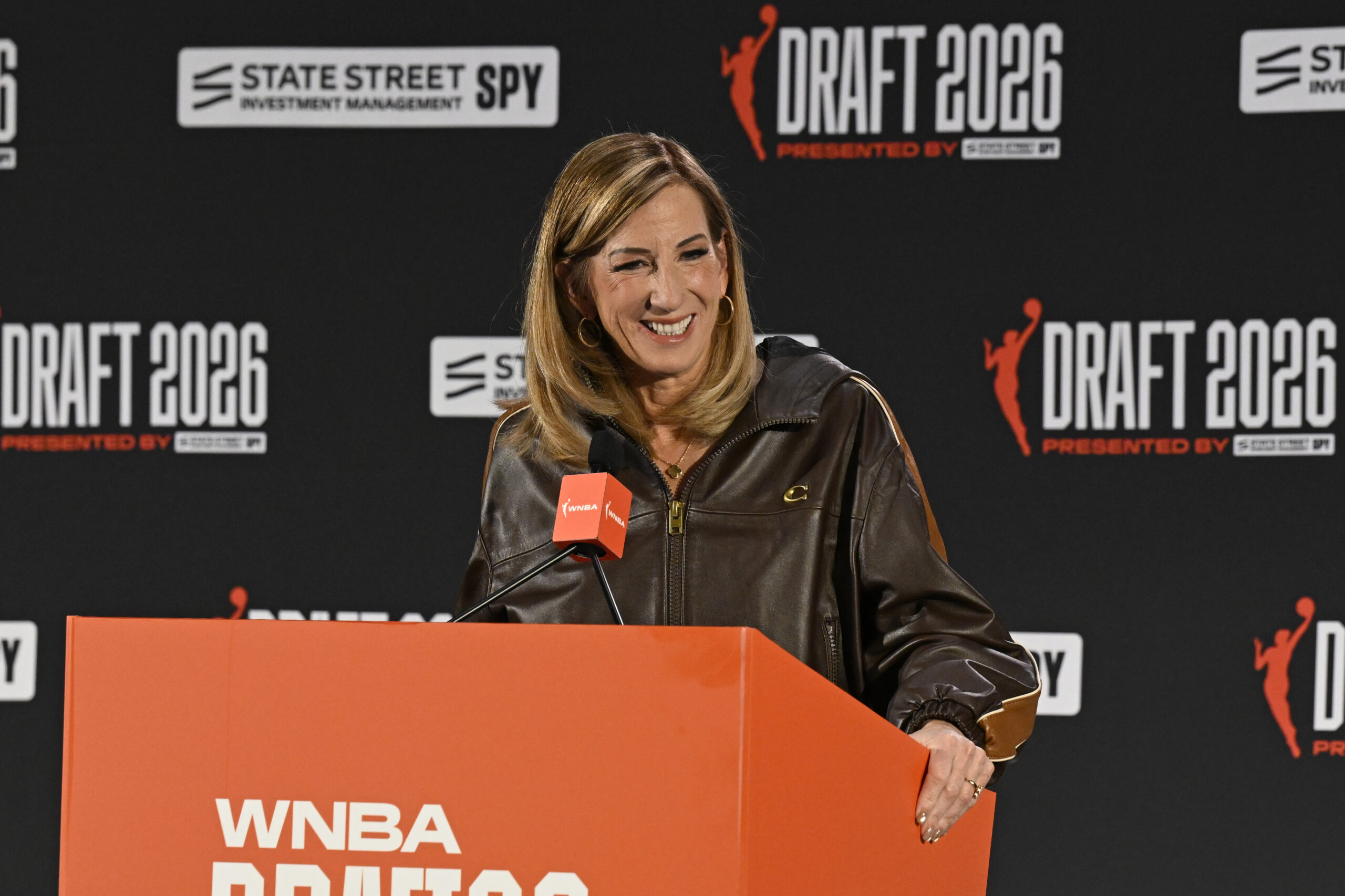
This week’s WNBA Draft afforded commissioner Cathy Engelbert her first chance at extensive comments since the signing of a new CBA.
At the podium, commissioner Cathy Engelbert went on the clock in the final hour that preceded the 2026 WNBA Draft.
Engelbert engaged in her longest public comment session since her league and its players came to terms on a historic collective bargaining agreement that dominated much of the offseason.
With the framework formed and rookie reveals coming shortly after, Engelbert spoke about the league’s landmark 30th season, further off-court meetings centered on quality of play for both participants and officials, hinting at innovations like a seasonal expansion to 52 games and games played on non-North American surfaces, and, of course, the impending ratification of the new CBA negotiated at the nearby Langham Hotel.
“The past 30 years have been about building the foundation. The next 30 are about scaling the game, unlocking what’s possible for the entirety of women’s basketball and women’s sports,” Engelbert said in her opening statements. “Season 30 arrives at what I think is the perfect moment … this starts a new chapter, and I can’t wait for what’s ahead.”
Once Engelbert took questions, several responses stood out …
The “Sunset Season”
“Coming off a significant expansion process for WNBA, we had 13 cities bidding on, remember, what we thought was one team that we would grant. Maybe it was 18 months ago now. Obviously, we’ve now announced Cleveland, Detroit, and Philadelphia in ’28, ’29, and ’30. We did not receive a bid from the Boston market or the New England market, obviously, with the Connecticut team there.”
“The Mohegan Tribe then hired a banker to represent them in the potential sale. I think it started with a variety of options, a partial sale, a minority sale. Ultimately, they did reach the agreement that you’ve read about. We’ve not got anything final at the WNBA yet. When we get that agreement, we will put that through our governance process. It will be subject to our Board of Governors vote.”
“Obviously, Connecticut has the opportunity under the sunset season. So I would say to the fans: support the Connecticut Sun this season. It’s a great basketball state, obviously, for women’s basketball. Some would call it the center of women’s basketball with how successful UConn’s been over so many years. I would say stick with us. Stick with the WNBA. We know that fandom won’t go away.”
One of the first issues Engelbert was asked about in her annual draft address was the sale of the Connecticut Sun. The endgame yields the long-sought return of the Houston Comets, albeit at the cost of a long-standing WNBA home in Uncasville.
Such a sale carries a lasting controversy: early reports indicated that the Sun would be sold to a New England-based group headed by former Boston Celtics co-owner Steve Pagliuca. But the league instead turned to its expansion pool for the eventual replacement, accepting a smaller bid from the Houston Rockets’ ownership, led by Tilman Fertitta.
Unlike, say, the Cleveland Browns’ transfer to Baltimore (where it assured that Cleveland would get a team to replace the one it lost), Engelbert’s forecast offers a not-so-rosy picture of the league’s future plans in New England. It’s one where the UConn Huskies, fresh off yet another women’s Final Four appearance, will essentially continue to serve as a de facto farm club. It’s not as ludicrous of a gamble as it sounds on paper—UConn had but two women chosen in the draft, which garnered some of the strongest television numbers in the history of the event—but the league’s stance on the move likely won’t be received well in the region.
Officiating Changes
“I think, as I mentioned in the Finals presser, you know, we were evaluating plays, physicality, calls, non-calls, kind of just trying to determine where the line should be. We had input from players, including players on the Executive Committee of the PA. We had inputs from college coaches. Because I don’t know if you watched the Final Four, there were pretty physical games going on there, and pretty great. We had input, obviously, from hours and hours of review by the GMs, head coaches, and the rest of our stakeholders. More to come on exactly what that will mean, but I think you’ll see some changes in the officiating around that physicality this year.
Obviously, it’s going to take all sides to get used to it, the players and the officials. I think that will play out over the year. But we certainly want to make sure that we’re putting on the best product on the court. Obviously, it’s going to be a physical game. But you know, we’ve got to draw lines, and I think you’ll see more lines being drawn around that physicality as a result of some of the insights we gleaned from the State of the Game committee, and what I’ll call officiating subcommittee, where those were the people that were really watching the hundreds of hours of film.”
The labor negotiations masked, or at least temporarily drove, one of the league’s glaring issues out of the spotlight: the final stanzas of last season were partly marred by continued concerns about officiating, which culminated in some high-profile coaching ejections on the biggest stages (i.e., Cheryl Reeve in the semifinals, Nate Tibbetts in the closing hours of the Finals).
“I wonder whether you would ask that of a man.”
Cathy Engelbert’s response to the question of how much longer she anticipates being the WNBA’s commissioner
pic.twitter.com/7FZ3Yxgq7w
— Yahoo Sports (@YahooSports) April 13, 2026

Engelbert’s update on a de facto officiating task force and study group is an assuring sign that the league did its due diligence behind-the-scenes while the sought-after numbers were chased. Regardless of how much longer she lasts (a query about her continued standing as league commissioner led Engelbert to accuse the questioner of whether the same post would be presented to a man), Engelbert does go down as the commissioner that helped oversee the passing of this historic CBA. Tensions with the players appear to have been soothed, as she shared a brief anecdote about speaking with Nneka Ogwumike at the draft and toasting her return to Los Angeles.
Now, however, the focus turns to the on-court product, where the talent has never been better stockpiled. An undeniable stain, however, would emerge if the narratives of the biggest games continue to be hijacked by officiating. It’s definitely a point in the league’s corner that a task force was formed while business was handled at the Langham.
Now What?
“Of course, there’s a lot of things we learned. Of course, we would maybe do a few things differently next time. But I think in the final analysis, it’s almost like you had to have the process as it is. If we had gotten done much earlier, I’m sure the players wouldn’t have felt like they won, and the owners wouldn’t have felt good about it. I think we got to a really good place at the end. There were eight long days and nights. Next time I don’t recommend a lot of all-nighters like that. So that’s the number one takeaway.
But I think in the final analysis, I think we really came together. The players were emotional. I mean, I’m pretty emotional seeing already 23 million-dollar contracts signed only two and a half days into free agency. That’s pretty incredible. Now these players can build real generational wealth, including not just their salaries, their benefits and their 401(k) benefit, and build real retirement and things like that. So I’m so proud of what we did together. I think it’s a moment in time we’ll remember for a decade or two.”
As Jedi Master Yoda remarked, always in motion the future is. This new CBA has only tipped off (she humorously quipped “What have you done for me lately?” when asked about the road ahead), but Engelbert’s comments hint that there was plenty to learn and glean from the recent negotiations that could come in handy when it’s time to return to the boardroom in 2032.
What was said this time around at least gives the players and league a starting foundation to work with. Engelbert noted that the league learned that housing was a major point of contention in the early going, while also noting that maintaining “professionalism” was a relative non-negotiable. While Engelbert acknowledged that an early agreement might not have worked in the players’ favor, she noted that all sides took notes on how to avoid the negotiations stretching out into all-nighters the week before the project is due.
Ultimately, Engelbert goes down as the commissioner who helped oversee this deal, and no one can take that away from her. A further legacy, however, is on the line, one that will expand beyond the boardroom. While the casual fan will ultimately judge Engelbert by the on-court stories, the die-hards and de facto player armies will analyze through the way their idols are taken care of.
Contracting the Expansion
“I think the more opportunities we can give players and then adding the development players…will be a great opportunity to give more players to develop into WNBA professional basketball players. I understand the balance here, and we’ve been evaluating that. That’s why again, two this year, none next year, and then one in ’28 and one in ’29 and one in ’30.
But you do also need scale, too, and I think the competition will be really good. I think we’re going to look at a lot of teams this year that can compete, especially with the free agency period, with a lot of players switching teams. I think you’ll see that next year into the ’28, because ’28 will be another, at least at that point, one-team expansion draft.”
With the WNBA expanding at a seemingly record rate, the risk of getting too big too fast is quietly prevalent. But Engelbert seems satisfied with the current pace of growth: while the league has continued to fulfill its expansion dreams, the discussion is curbed for 2027 (beyond the Connecticut move to Houston) before Cleveland gets the ball rolling again the year after.
The rosters of the incoming Portland Fire and Toronto Tempo have come in relatively seamlessly despite the time crunch brought about by the lasting negotiations, as each has assembled relatively competitive squads through the draft and free agency (Toronto particularly doing so with a core headlined by Marina Mabrey). That, however, was the easy part: with newfound great financial power brought about by the CBA comes great responsibility, and Engelbert assured that methods of detection and discipline of cap circumvention were in development.
With the new roster spots generated, including the pair of developmental contracts that teams will be able to take advantage of, there will be more opportunities afforded to players, whether they’re young potential-packed projects entering the league or veterans seeking to etch out a professional standing. It seems that safeguards are being developed to make sure there’s no watering down of the product that has generated sterling momentum in the ongoing decade.
Like any flash-in-the-pan explosives, the major happening has been handled in the form of signing the CBA. Keeping that momentum, of course, is the hard, and more important part and it appears Engelbert has a plan to keep the cogs spinning.
Geoff Magliocchetti is on X @GeoffJMags
The post 4 Quotes from Cathy Engelbert at the 2026 WNBA Draft (and What They Mean) appeared first on Ballislife.com.