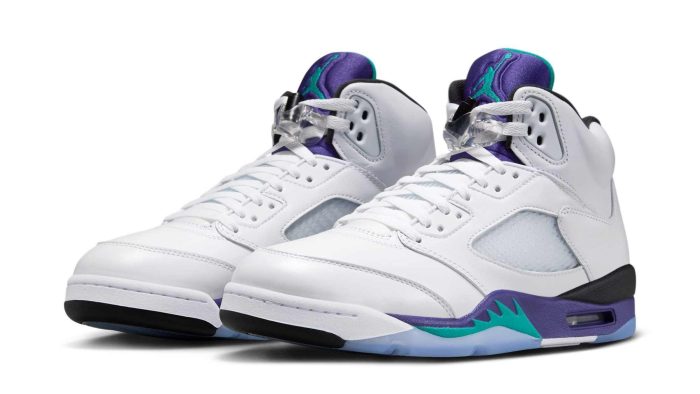
One day after the calendar officially flips to summer, sneakerheads of a certain age will pray that their god of choice blesses them with a pair of the Air Jordan 5 “Grape.” June 21 marks the first time Jordan Brand has released the colorway in OG form since 2013.
The 2025 model improves on the Obama-era pair by utilizing quality leather, a translucent outsole, etching the Nike branding on the heel, and incorporating a polyurethane insole to make Nike “Air” more than just a clever tagline.

Jordan Brand
Even without those improvements, the latest release would still garner attention from any publication covering sneakers with even an ounce of credibility. For three decades, the shoe has remained a cultural holy grail, more than likely due to its association with who wore it off the court: a kid from West Philadelphia, born and raised.
The Fresh Prince of Bel-Air debuted on NBC in 1990, the year Nike unleashed the Air Jordan 5. The sneaker was embedded in the show’s DNA from the opening credits to the first moment America met Will Smith. Smith, the actor and the character, made the Jordan 5s his own.
That the show displayed them prominently, not only added to Smith’s character but also cemented the symbiotic relationship between Jordan and the burgeoning Black Culture infiltrating homes across the land weekly. The Fresh Prince of Bel-Air was one piece of a larger Black television tableau that broke barriers and kicked down doors in ‘90, often while wearing the Jordan 5.
“For me, the big thing was color,” said Smith on an episode of Complex’s Sneaker Shopping. “The Fresh Prince and the attitude of the character was always color.” With that perspective, it’s painfully obvious what attracted Smith to the “Grape” colorway on the show’s fifth episode.
“Homeboy, Sweet, Homeboy,” featuring a young Don Cheadle, saw the Banks’ nephew rocking the kicks in a Charlotte Hornets-esque color scheme with a purple hat, emerald-colored shirt, and pants best described as “only from the ‘90s.”
The shoe got a brighter spotlight on the show than the court since Jordan only wore them on a Wheaties box. No disrespect to the “Breakfast of Champions,” but a cereal box’s reach paled in comparison to that of a prime-time sitcom on what was then one of the big three networks.

Chris Cuffaio/NBCU Photo Bank
Before streaming, social media clips and NBA League Pass, one couldn’t just stumble onto a basketball game any given night in 1990. CBS, TBS and TNT aired national games, but the latter two networks were only available in households with cable TV subscriptions. And even then, there was no guarantee Jordan fans would see him even once a week, let alone twice.
The biggest national stage for any professional basketball player was the NBA Finals, one that remained elusive to Jordan’s Chicago Bulls until 1991. Shows such as Fresh Prince offered consistent exposure to audiences who couldn’t see the Bulls play.
On average, 12 million people watched the 1990 NBA Finals, a five-game series between the Detroit Pistons and the Portland Trail Blazers. The Fresh Prince averaged 13 million viewers per week for 25 weeks. The weekly consistency meant everything to me as a 4-year-old. Sure, I knew of Jordan, but not in the way I would a year later, once those Gatorade “Be Like Mike” ads became a thing after he won his first championship. West Philly’s favorite son was cooler to me at the time and much more influential, possibly due to accessibility.

Chris Haston/NBCU Photo Bank
The Air Jordan 5 was dope because Will Smith was dope. He wore the sneakers to formal events. He wore his high school blazer inside out. And he stood out like a pair of Timbs among Bel-Air penny loafers. Smith’s arrival into the Banks’ lives mirrored Fresh Prince’s place in pop culture at the time, effectively injecting Black youth culture into American suburbia’s bloodstream one week at a time. And yeah, the NBC sitcom wasn’t the only one.
A Different World and In Living Color brought a rebellious nature to television. Like Fresh Prince, their mere existence was transgressive. They dared to show Black young adults on a college campus, or present a sketch comedy show where those without melanin were the minorities on set. That wasn’t the landscape prior to their inception. A Different World and In Living Color didn’t just upset the apple cart, but rather they tipped it over and threw the apples at the status quo.
Like Jordan, the nationally televised programs presented a different energy to an audience more accustomed to the Banks or the Huxtables (The Cosby Show), or Black characters whose actions raised questions about whether it was OK for them to exist. Those three television shows, rooted in the multiple shades of the Black experience, didn’t do much asking.
Forgive the cliche, but they were unapologetic before that became a cute slogan for T-shirts. And fashion played a role in bolstering that attitude. The Jordan 5s showed up on Dwayne Wayne’s (Kadeem Hardison) feet, as well as Damon Wayans’ during a sketch or two. When cutting-edge shows lent their cache to Jordan, it said he was cut from the same hard-to-find cloth.
Smith felt the Jordan 5s were from the future, as nothing looked like them in 1990. No doubt that made them the perfect companion for anyone looking to ruffle a few feathers. Even better when that “anyone” happened to be an assortment of similarly-minded people.
Perhaps that unique look and association with the defiant Black renaissance is what subconsciously drew me to the Grapes, and what keeps me coming back. Originally released in 1990, this was an unconventional colorway released at a time when conventional was boring. The backward flames on the sole already signify something different, but the Grape 5s present them in emerald green.
That design choice has more in common with flames from The Wizard of Oz than actual fire. Famed Nike designer Tinker Hatfield noted that he and Jordan wanted the 1990 release to “zig” while the competition did the opposite. The Grapes were made famous by a television character who did a lot of zigging while the rest of Bel-Air followed the straight and narrow. Phillip and Vivian Banks’ nephew represented a movement that took the same approach as it tightened its vice grip around every facet of pop culture. Jordan Brand even released a Fresh Prince-inspired pair in 2018, sans laces, of course.
Of every sneaker in Jordan Brand’s stable, this is the one that calls to me like a siren and elicits a Pavlovian response. Missing the 2018 release still stings a bit, but in my defense, a lot was happening that year. Air Jordan’s fifth edition sparked my eternal flame for Jordans – a love born from watching Smith on TV every week while having a mother who loved MJ and wanted her son to be fly.
After ‘90, Black Culture further entrenched itself atop the totem pole of cool, and Jordan was a huge facet of that story as fate or a deity shaped the decade. Martin, Family Matters, Living Single, The Wayans Bros., and The Jamie Foxx Show are a few examples of shows that proudly professed their love for His Airness’ footwear.
Will Smith and The Fresh Prince of Bel-Air were the proverbial “calm before the storm.” They ran with the baton that the prior Black shows handed them, but reshaped the race entirely with Smith leading the charge. Without him, the Grape 5s wouldn’t have endured for this long, and a significant piece of the Jordan puzzle wouldn’t exist.
Leave a Reply