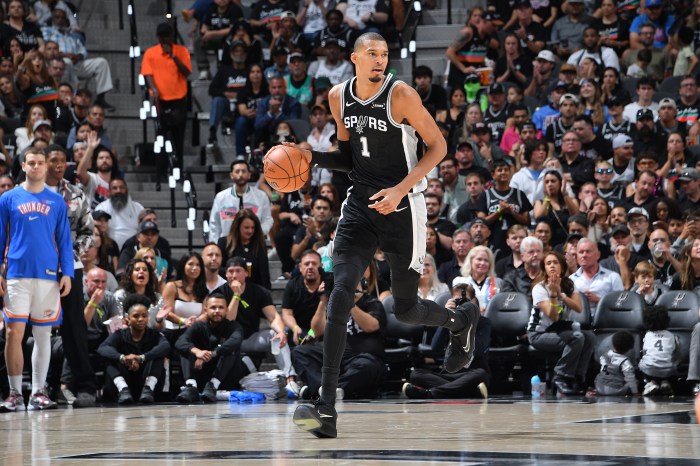
SAN ANTONIO — Beginning Wednesday with Game 1, the New York Knicks will take on the San Antonio Spurs in one of the most anticipated NBA Finals in years.
The interest is largely due to Victor Wembanyama, the Spurs’ 22-year-old, 7-foot-4 superstar center. In his third NBA season, Wembanyama is being called a generational player and the NBA’s best player. Some have called him the best talent in NBA history.
His presence is a large reason why the Knicks, who have enjoyed an epic postseason run of 11 consecutive wins, are cast as underdogs. Because of Wemby, as Wembanyama is called, the large-market Knicks are Davids against the smaller-market Spurs’ Goliath.
The praise heaped on Wembanyama is well deserved, though I wonder if the term “generational” is a bit premature. How do we know he’ll be generational?
We tend to throw out these terms, whether it’s “great” or “future Hall of Famer” and now generational, without defining what we mean or what criteria we’re using to make the determination. We’re in a rush; I realize that. We want to plant an oak tree and see it grow to its full height overnight.
We each have our own standard for what constitutes a generational player. One guideline that is often used to define a generational player is someone who forces a league to change its rules, or someone who changes the way a game is played.
Might Wembanyama force a rulebook change, such as raising the height of the basket?
And even if he does, not everyone who forces a rules change or introduces something new to a sport is widely considered a generational athlete.
R.C. “Alley-Oop” Owens, for example, was the inspiration behind the alley-oop pass with quarterback Y.A. Tittle. Plus, in 1962, Owens, then with the Baltimore Colts, blocked a field goal by standing under the goalpost and leaping to swat a field goal attempt away before the ball cleared the crossbar. Thanks to Owens, the NFL outlawed that kind of goaltending.
Owens forced a rule change and helped create a new type of play, but he is not generational.
How else might you define a generational player? Is it someone who makes you say, “I’ve never seen that before?” Wembanyama’s case in this regard is more of an instance of evolution than revolution, his uniqueness owing to his combination of size, athleticism and coordination.
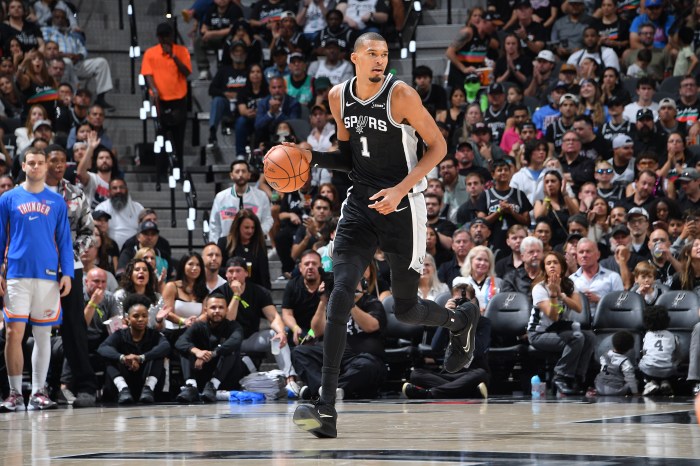
Michael Gonzales/NBAE via Getty Images
And while every generation has an athlete who does something we have never seen before, there can be different reasons behind each example.
Boxing fans early in the 20th century had never seen an extraordinary Black heavyweight champion, because African Americans were not allowed to compete for the heavyweight championship. When Jack Johnson won the title in 1908, sportswriters and fans no doubt said, “We’ve never seen this before,” because they hadn’t. Of course, the reaction back then was not to shower Jackson with praise but to find a way to eliminate him by finding a Great White Hope.
Similarly, when Jackie Robinson desegregated Major League Baseball, a number of baseball fans probably said, “We’ve never seen anything like this,” when they saw Robinson steal bases and steal home. Had they been familiar with Negro League Baseball, fans would have seen many athletes — some better than Robinson — stealing home.
Robinson was generational because he desegregated Major League Baseball. When baseball — and other professional sports — was desegregated, mainstream fans saw what they hadn’t seen before.
Then, there’s the role of longevity. Some athletes dominate their particular generation. Other athletes are generational because they only come around once in a lifetime.
Muhammad Ali evolved into a once in a lifetime athlete, first coming to prominence when he won the heavyweight boxing championship by upsetting Sonny Liston at age 22. What ultimately made him generational was standing the test of time — winning championships but then changing his name, becoming a Muslim and then risking his title and his ability to make a living by taking a stance against the Vietnam War and refusing to be inducted into the Army. He paid a price for his stance: He was stripped of his title. That made him generational.
With Wembanyama just 22 years old and in his third NBA season, it’s far too early to gauge how long he will remain among the sport’s best and what cultural significance he may or may not hold.
And what does a contemporary athlete have to do to become generational? Does an athlete need to win a championship or lead a team to one to become “generational”?
Los Angeles Lakers forward LeBron James provides a blueprint. James evolved into a generational player.
Now 41, James completed his 23rd season last month. For at least 20 of those seasons, he has been the NBA’s dominant player. He evolved into a generational player with longevity, successfully competing against different generations of stars and winning multiple championships after once being dogged by questions over his playoff performance.
So perhaps the proper question to ask about Wembanyama is whether he will evolve into a generational player.
But as the NBA Finals begin, the conversation around Wembanyama will intensify, and so will the questions: Is he already a generational player? Does he have to win a ring to be given generational status?
I’ve come up with my own short list of athletes who could be called generational, because we’ve had the benefit of witnessing the beginning, middle and in some cases, the ends of their careers.
Of course, athletics by definition has a 100% injury rate for participants, meaning health will figure into attaining generational status. How will injuries change the trajectory of a career? How will the athlete come back from injury? Will they be as dominant after being injured as they were before?
Will they stand the test of time?
The members of this list did.
Dick Raphael/NBAE via Getty Images
GEORGE MIKAN: When the 6-foot-10 Mikan joined what became the NBA in 1948, he became the league’s first dominant big man and prompted sportswriters and fans to say they had never seen anyone like him. Mikan, who died in 2005 at age 80, was not only tall, but he was agile and skilled.
Mikan forced the NBA to widen the free throw-lane from 6 feet to 12 feet in 1951, because he could camp underneath the basket and score virtually at will. His shot-blocking ability prompted the league to establish goaltending rules.
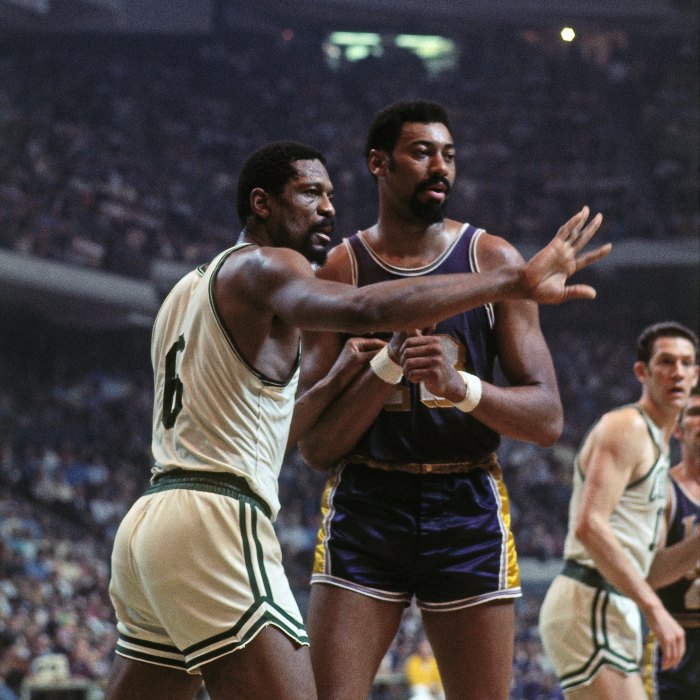
BILL RUSSELL: In 1964, the NBA widened the lane from 12 feet to 16 feet. The change was aimed primarily at limiting the dominance of big men. Russell’s defensive impact and athleticism were part of a broader era that forced the league to rethink how dominant centers affected the game. Russell also won 11 championships during his 13-year playing career, and his excellence changed how teams valued defense. He also was the NBA’s first Black head coach and broke a major racial barrier; his activism around civil rights issues expanded players’ awareness of becoming involved in civil rights issues.
WILT CHAMBERLAIN: When Chamberlain, a 7-foot-1 champion high jumper, emerged on the scene, sportswriters said the same thing about him that they are saying now about Wembanyama: “We’ve never seen anything like this.” The Philadelphia native was still at the University of Kansas when the NCAA widened the lane from 12 feet to 16 feet, and Chamberlain then caused the NBA to strengthen its offensive goaltending rules, prohibiting players from touching the ball while it was on or directly above the cylinder. And the league had to change its free throw rules, because Chamberlain, utilizing his track-and-field background, would take a running start from behind the free throw line and dunk or lay the ball in before defenders could react. To combat this, the league decided players cannot cross the line until the ball reaches the rim.
KAREEM ABDUL-JABBAR: Because of Abdul-Jabbar, the NCAA banned the dunk before the 1967-68 season, citing concerns about safety and broken backboards. In reality, the rule change was all about Abdul-Jabbar’s dominance. The ban lasted for nine years, until 1976. Abdul-Jabbar developed the skyhook, which became one of the most unstoppable weapons in basketball history.
WILLIE MAYS: The greatest all-around player in MLB history. Would have been great in any decade in any generation.
MICHAEL JORDAN: I’m not sure if there were any official NBA rules that developed because of Jordan, but I do know that the Detroit Pistons instituted what became known as Jordan Rules — a blueprint for mitigating Jordan’s unprecedented athleticism and explosiveness. The Pistons’ Jordan Rules were a defensive strategy created under head coach Chuck Daley: a system of double teams and tough physical play that forced Jordan into difficult areas of the court. Because of the Pistons’ physical tactics, the league intensified efforts to reduce physical play. But what made Jordan generational was off the court, as he became one of the most heavily marketed athletes in NBA history, proving that African American athletes could be successfully marketed to mainstream consumers. Jordan also led the Chicago Bulls to six NBA championships.
BARRY BONDS: Major League Baseball’s home run king and one of the greatest players in league history.
Garrett Ellwood/NBAE via Getty Images
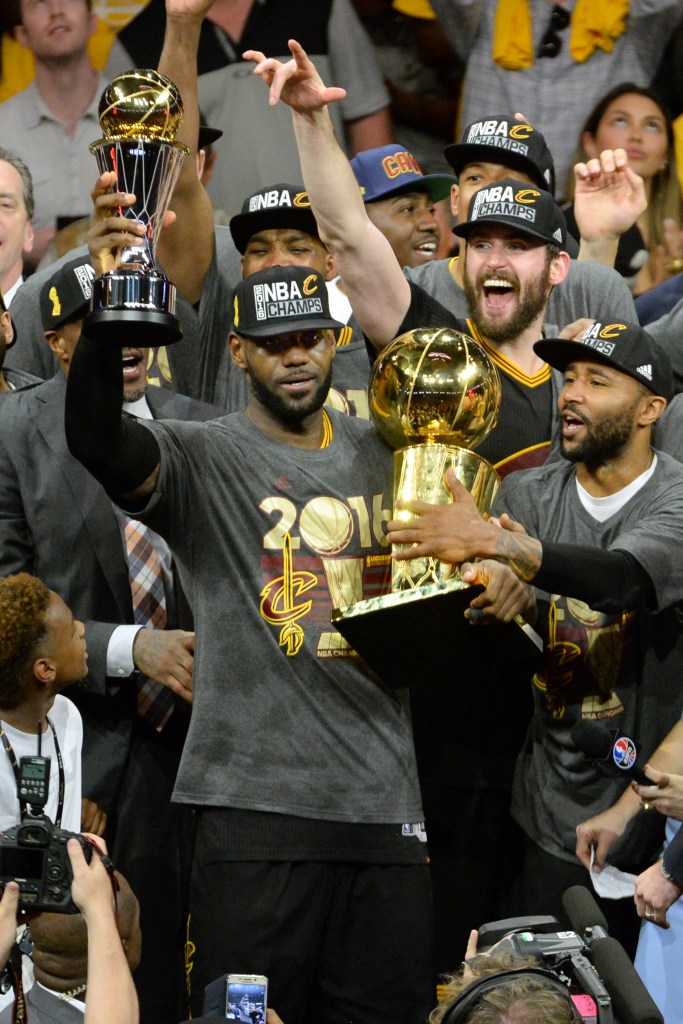
LEBRON JAMES: At 41 years old, James is THE definition of a generational player. He was predicted for greatness at age 18 and is one of the few athletes in any sport of any era who not only met such expectations but exceeded them. On and off the court, he has expanded the possibilities for athletes — especially Black ones — when it comes to creating one’s own brand, capitalizing on one’s name, and even speaking out against political issues and dynamics with which he disagrees. In 2017, James in a social media post famously called President Donald Trump “U Bum.” In many ways, that show of defiance helped steel the spines of many professional athletes and inspired many to go beyond running and jumping to publicly taking stands on issues.
TIGER WOODS: Woods changed professional golf dramatically in the late 1990s and 2000s. Tournament organizers, architects, and governing bodies began “Tiger Proofing” championship courses to keep elite players from overpowering the course.
PATRICK MAHOMES: Mahomes still has chapters to write, but he has changed the expectations of what an NFL quarterback can be and achieve. He is an elite passer, a mobile playmaker, a strong-armed thrower, and a leader. He has also won three Super Bowls, three Super Bowl MVP awards and two NFL MVP awards.
SERENA WILLIAMS: Williams introduced power, intensity and unprecedented competitiveness to women’s tennis. Almost overnight, she forced a number of players who had relied on finesse to either get out of the sport or dramatically change how they approached it. Serena won 23 Grand Slam singles titles, the most in the open era, and perhaps most importantly, she attracted a number of young African American women and women of color to tennis.
She also withstood the test of time, competing against winning players from different generations — and, just this week, announced a comeback to the sport after years of retirement.
MARTIN BUREAU / AFP via Getty Images
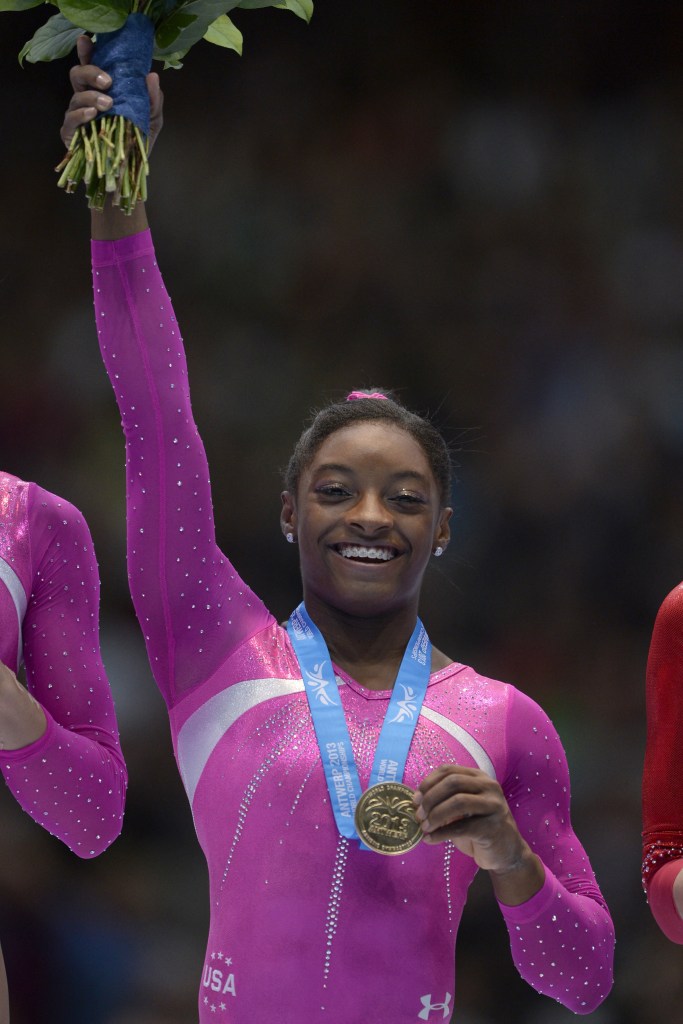
SIMONE BILES: She redefined what is possible in gymnastics. There are several skills in the sport that bear her name, because she was the first to perform them successfully in major international competition. That’s generational. She has also withstood the test of time. While many U.S. gymnasts can only maintain a high enough level to compete for world medals in one Olympic cycle, Biles has won world and Olympic medals across more than 10 years. During the 2020 Summer Games, Biles also illuminated the need for athletes to prioritize their mental health and safety over performance.
MUHAMMAD ALI: Ali was a great boxer, but what made him generational was that his influence extended beyond the ring. His fight over the draft helped define for a generation of athletes what it meant to stand up for rights and engage in social activism.
VICTOR WEMBANYAMA? Beginning with Game 1, we’ll see.
The post Wemby’s first NBA Finals: What makes a generational talent? appeared first on Andscape.
Leave a Reply