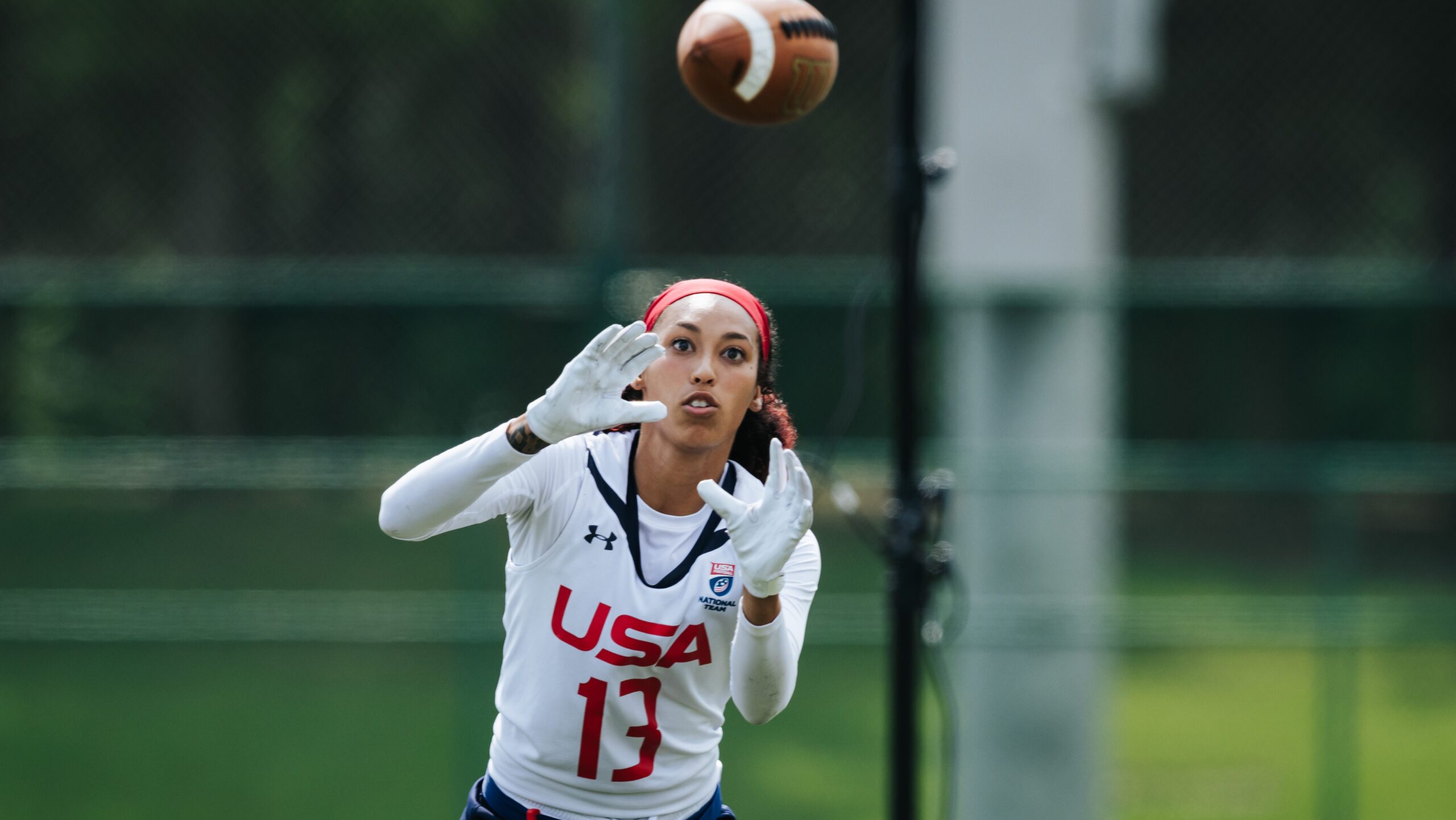
By age 6, Winston-Salem State freshman Eshé Muhammad knew she wanted to play football.
Inspired by her two brothers, who grew up playing tackle football, Muhammad was instantly drawn to her high school’s flag football team and the sport, despite having little insight into what opportunities existed beyond graduation.
That changed last year, when Muhammad’s parents — both alumni of Winston-Salem State — brought her to the inaugural Central Intercollegiate Athletic Association (CIAA) flag football championship game. Watching the Rams win the 2025 title, she knew she wanted to continue her career at a historically Black college or university (HBCU).
“I’ve always wanted to come to Winston because my parents are alumni, so I’ve grown up with the community. I’ve grown up around the school. So when I found out that they have flag football, it immediately drew me in,” said Muhammad, who joined the team this season.
HBCUs are positioning themselves at the forefront of women’s flag football, one of the fastest-growing sports in the country.
In 2024, Alabama State, a member of the Southwestern Athletic Conference (SWAC), became the first NCAA Division I school to offer a women’s flag football program.
The Division II CIAA, which launched flag football programs at seven member institutions in 2025, will become the first HBCU athletic conference to offer it as a varsity sport starting in the 2026-27 season.
In February, Wilberforce University, a member of the HBCU Athletic Conference (HBCUAC), and Edward Waters University, a member of the Southern Intercollegiate Athletic Conference (SIAC), both announced the launch of women’s flag football programs for 2026-27.
Winston-Salem State won its second consecutive CIAA flag football championship on April 11. Chea Johnson, Muhammad’s father, said he has been encouraged by the CIAA’s commitment to the growth of the sport. He said the conference’s willingness to sponsor women’s flag football, and the NCAA’s decision in January to designate it as an emerging sport, is creating opportunities for Muhammad and other Black women to compete at the collegiate level.
“I know they also play nonconference, and they played some of the PWIs [predominantly white institutions], so it just gives her the opportunity to continue to develop her craft, develop her skill, and you never know where it could take her,” Johnson said. “This is an experience that she’ll be able to take with her and share with those coming behind her.”
Muhammad’s sophomore teammate Alani Butler has been a part of both of the Rams’ CIAA championships, giving her a front-row view of the sport’s evolution.
“Seeing how fast we’re growing, especially as a conference as a whole, we’re really making a big impact on the world,” Butler said. “Though we may be small because we’re a Division II school, we’re showing people that no matter the division, you can always win big.
“It makes me feel good knowing that people can look at us and know that we started something great, and it also helps us to know that we are encouraging people to do more.”
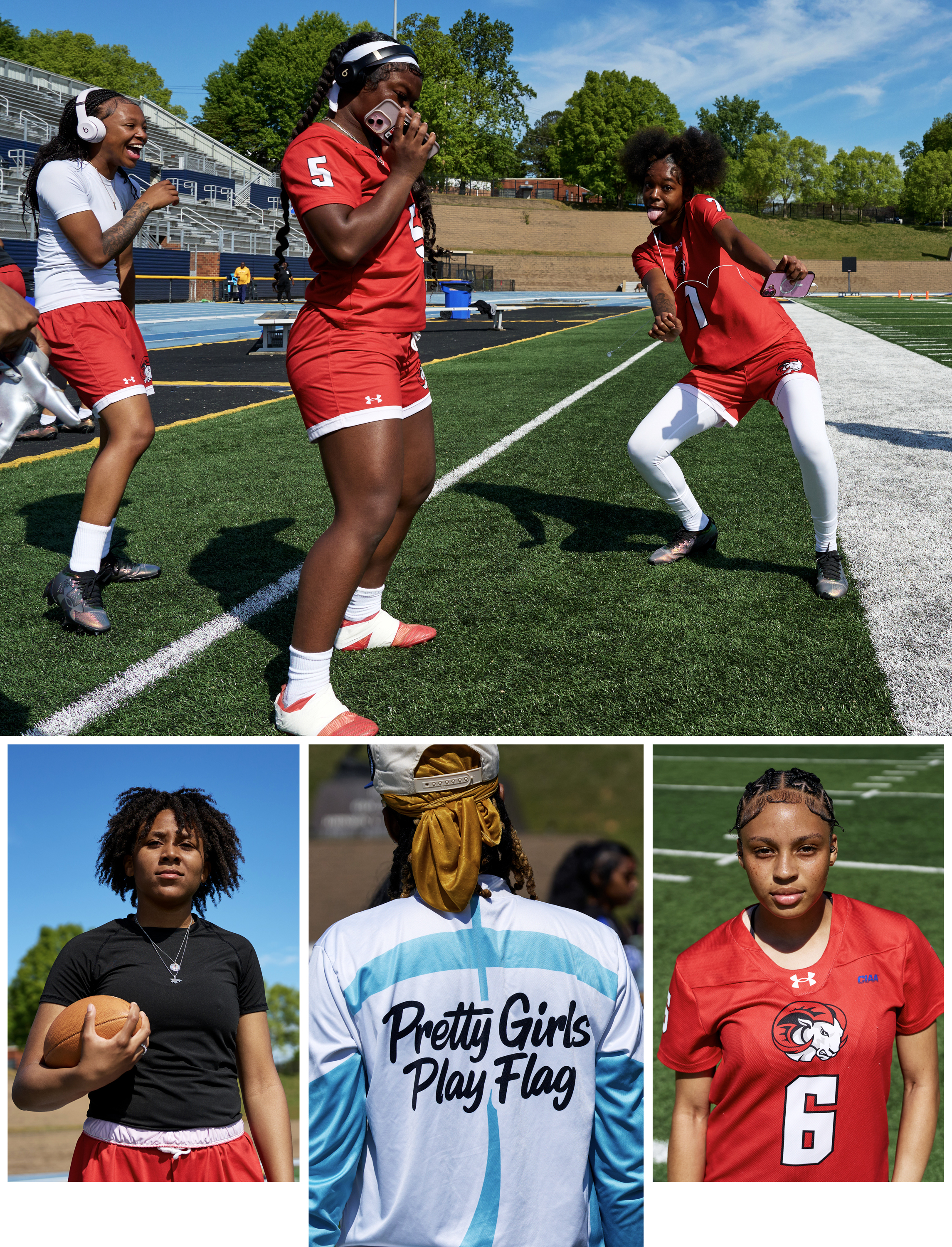
Matt Ramey for Andscape
For earlier generations of flag football athletes, opportunities to play the sport were limited to intramural and club teams, which often required players to pay to compete.
Winston-Salem State assistant coach Chasity Holt, for instance, played flag football for nearly a decade but never got to compete in college. When she joined Winston-Salem State’s coaching staff in March, she welcomed the chance to help develop the next generation of women’s flag football players.
“CIAA said, ‘We believe in our women. We want them to have opportunities,’ and they’re asking everyone else to step up,” Holt said. “So now you do see some of those DI [schools] saying they’ll have programs because they’re essentially behind the curve.”
She hopes the momentum flag football has generated will lead to more scholarship opportunities.
“Schools that aren’t on board yet just don’t trust or believe in the program or in the sport itself,” Holt said. “They don’t see the benefit of having the sport. But you can see the schools that have the sport are flourishing. They’re thriving.
“I just hope that leaders at these institutions that are hesitant see the value and see how much of a buzz [HBCUs] are creating and are able to sustain throughout the next couple of years.”
After being a multisport athlete in high school, Claflin University senior Jamya Kennedy didn’t compete in sports during her first two years in college. However, she loved playing intramural flag football as a stress reliever from her academic workload.
Once the CIAA added flag football and fielded teams for a championship, she committed to training hard and joined Claflin’s inaugural team in 2025. She said competing for Claflin in a league filled with other Black and brown female athletes has shifted the way her family views women’s flag football.
“When I told my mama I wanted to play flag, she told me, ‘So you just want to be a little boy.’ But now she sees that it’s all different types of ladies out here, and that we’re all just working toward something greater. She loves it now,” Kennedy said.
“A lot of us have always had an interest in football, but we always thought it was a boys’ sport, so this just gives us a way to play. It’s showing us flag football, or football in general, is for everybody.”
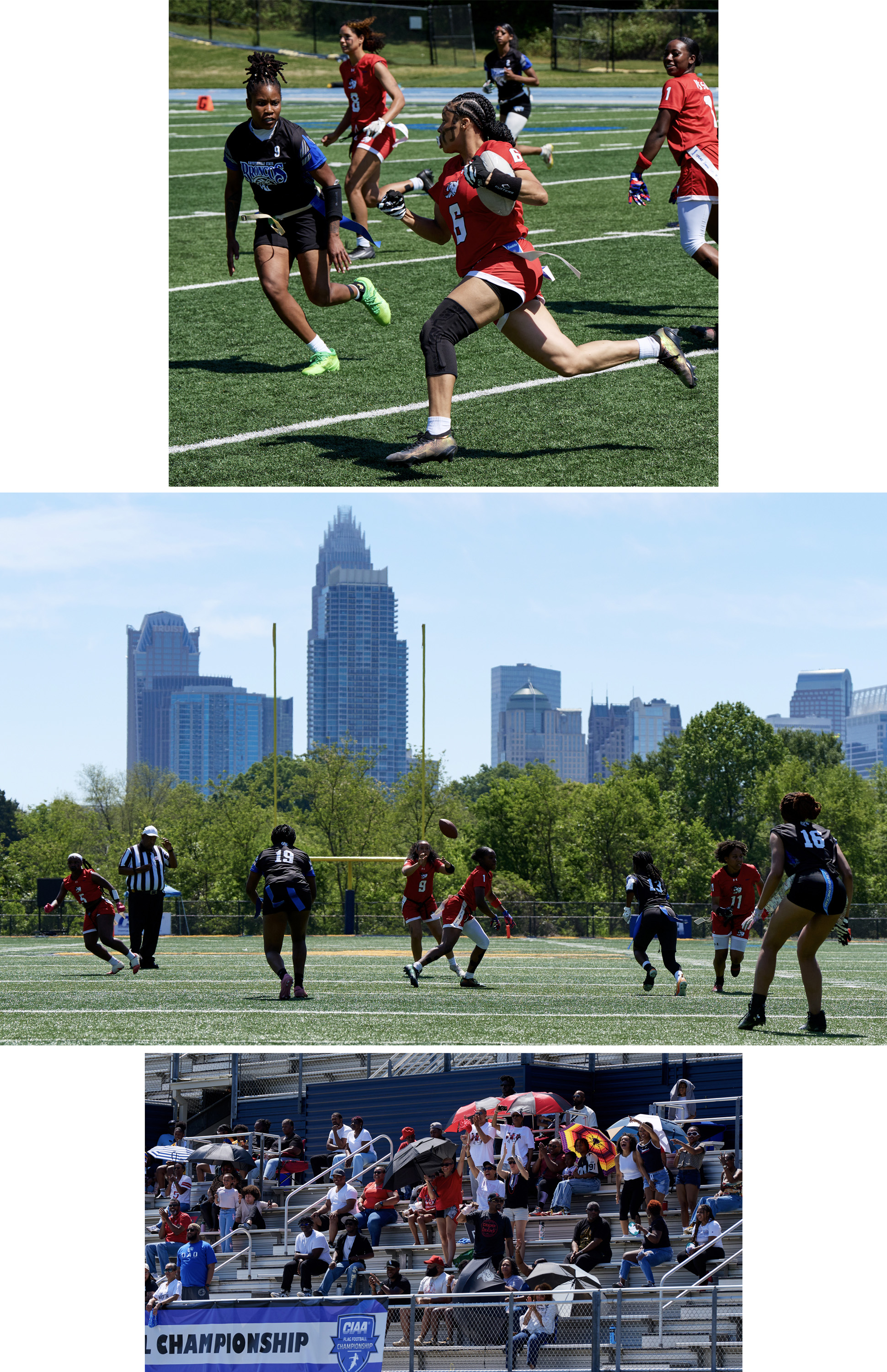
Matt Ramey for Andscape
CIAA commissioner Jacqie McWilliams Parker said the conference studied the sport’s structure, costs and growth at other levels before deciding to add it to the conference’s offerings. Since its launch, she said, it has increased exposure for the conference and its member institutions.
”We’re finding that women’s flag football — it’s probably been our [Black women’s] natural sport to play — but now that we actually have it, and you know this footprint that we’re in, I know it’s continuing to grow,” she said. “When there’s interest, if you can provide access and opportunity, then there’s growth and visibility.”
McWilliams Parker said she has been in communication with other HBCU conferences — the Mid-Eastern Athletic Conference (MEAC), SIAC and SWAC — about collaborative ways to further elevate the sport’s visibility across Division I and Division II programs.
“I think [flag football] is a chance for us to all bring MEAC, CIAA, SIAC and SWAC institutions together … and if we work with our other HBCU institutions, I’m pretty sure we could have a very eventful women’s flag football championship,” she said.
MEAC commissioner Sonja Stills has been laying the groundwork to potentially add women’s flag football, researching a financial model and Title IX implications, and seeking grants and sponsorships to offset costs for member institutions. The conference has hosted a girls’ flag football clinic for the past three years to promote the sport’s growth and engage prospective student-athletes.
The Alabama State women’s flag football team competes as an independent, outside of a conference.
Under head coach Tyrone Poole, Alabama State has continued to build its profile. This season, the Hornets added high-profile talent in Kiona “Ki’Lolo” Westerlund, a former U.S. national team member with experience in international competition.
Last year, Westerlund, the first recipient of a Division I flag football scholarship, appeared in the “NFL Flag 50” national advertising campaign for Super Bowl LIX. In April, the Hornets competed at the Fiesta Bowl Flag Football Classic, where they were the No. 6 seed and the only Division I varsity program in a field comprising mostly club teams.
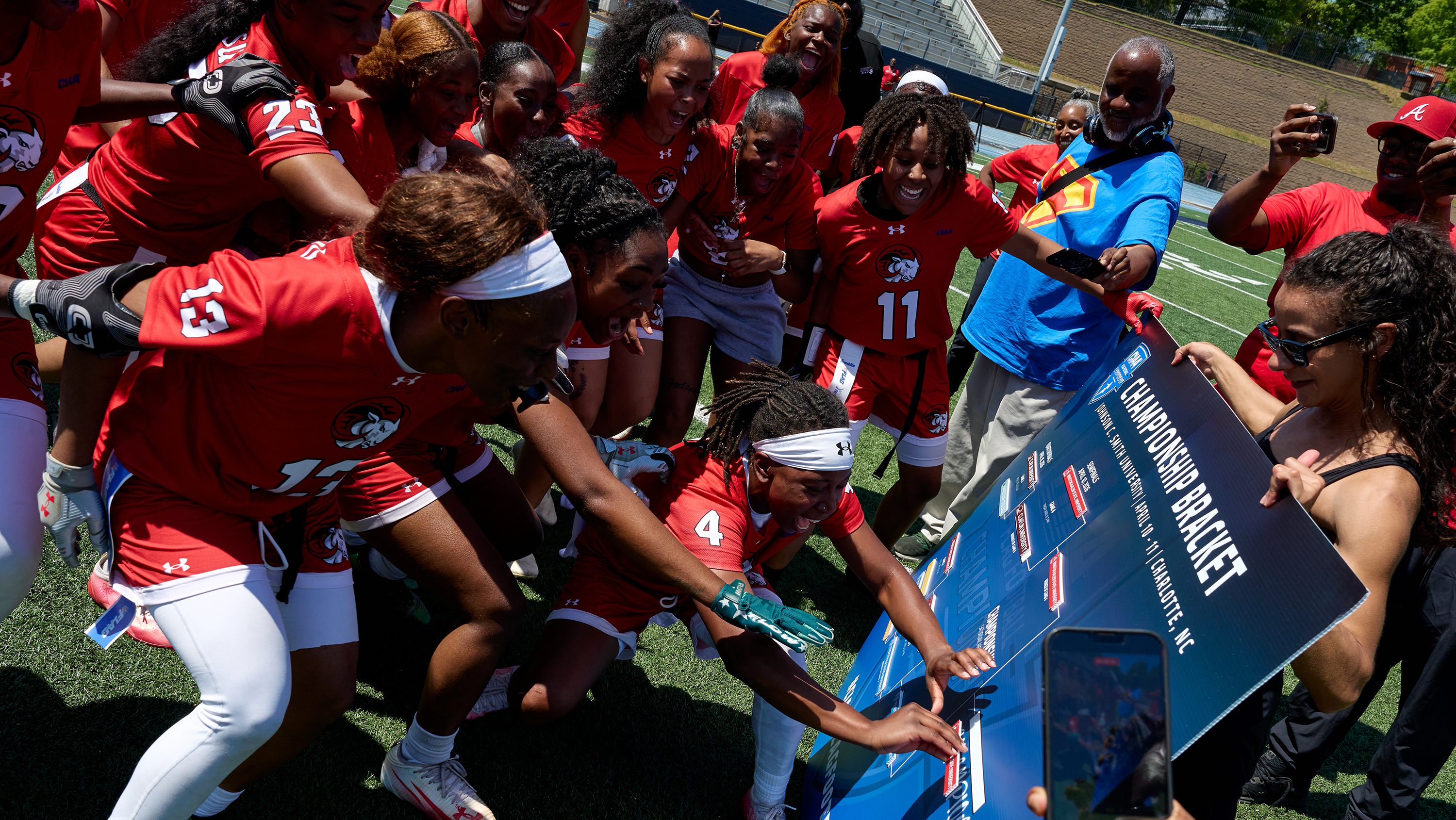
Matt Ramey for Andscape
Alabama State sophomore wide receiver and linebacker Shelby Shaffer relocated from Arizona in 2024 to join the Hornets.
“Now that it’s our second year, I’m seeing all the pieces come together,” Shaffer said. “Everything’s starting to form — like, all the hard work and extra hours that we put in — and [we’re] starting to build something that we want to see in the future.
“We’re starting to realize that it’s getting more serious when it comes to growing the sport, because as pioneers we’re pouring into the fact that the sport is growing. So we want to make sure that everything we do is with intention.”
Many CIAA coaches and administrators believe HBCUs are well positioned to produce Olympic-caliber athletes and create a recruiting pipeline for elite talent ahead of the 2028 Summer Games in Los Angeles, where flag football is set to make its Olympic debut.
“If there’s the next level [or] if there’s opportunities, which we know there are, we want to be a part of that pipeline,” McWilliams Parker said. “Whether we get there or not, we don’t get to make those choices, but we can put our students and athletes in a position to be seen so that they can see our kids are just as good as anybody else.”
The post Historically Black colleges take the lead in driving the growth of women’s flag football appeared first on Andscape.
Leave a Reply