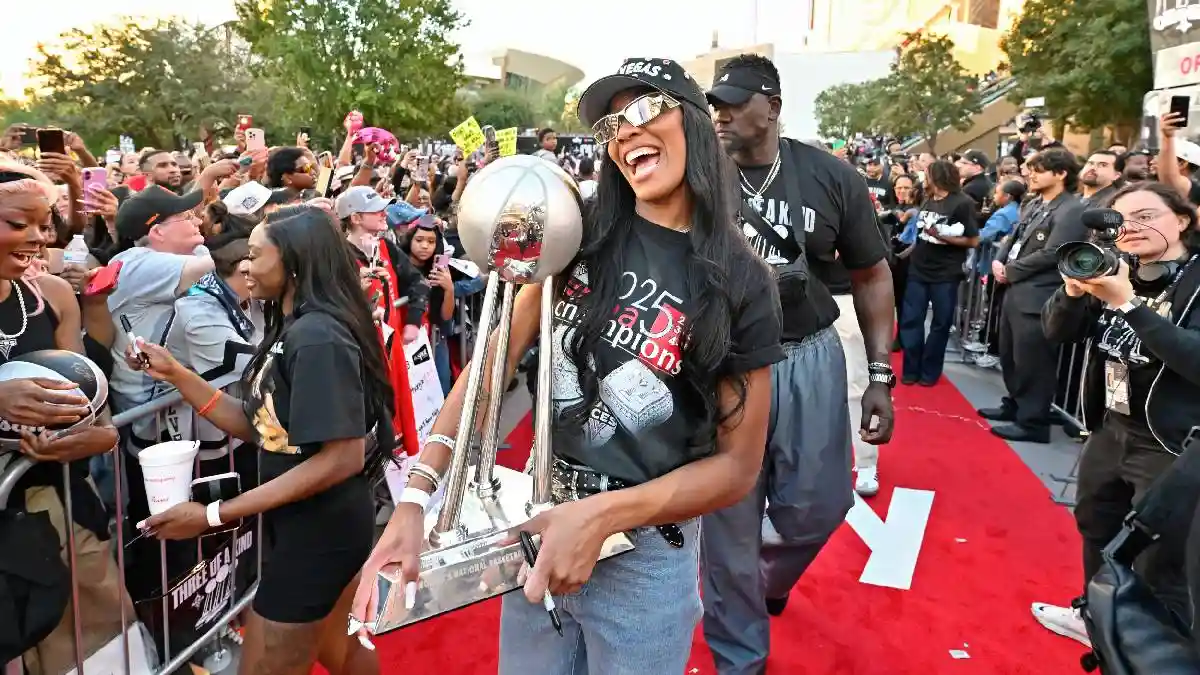


With the 30th hoist within striking distance, it’s time to attach a name to the trophy granted at the end of the WNBA Finals.
What’s in a name? That which we call a WNBA championship by another name would taste as sweet.
Every football player yearns to lift the Lombardi. NBA participants seek to obtain the Larry O’Brien. Those on the NHL’s ice seek to socialize with Stanley. MLB’s season is capped with the crowning via the Commissioner’s Trophy.
Yet, amidst its meteoric rise into the mainstream, the WNBA has yet to follow suit, as its contestants play for long-sought silverware depicting a basketball supported by three beams. The trophy will appear on the jersey of the teams competing for it come October, as the WNBA released a new logo for the 2026 Finals, one that grants the prize a prominent posting as opposed to the more muted prior version.
The WNBA has unveiled a new logo ahead of the 2026 WNBA Finals. pic.twitter.com/6swhCYU6dq
— Front Office Sports (@FOS) August 30, 2026
Yet, the trophy carries no official moniker or nickname, a rather glaring happening as the league continues to penetrate the headlining sports conversation. The omission is particularly glaring with the league engaged in its landmark 30th anniversary season, one that has paid proper tribute to the past with a focus on an evolving future. The league and its players no doubt have larger issues to solve but adding any sort of title to professional women’s basketball’s ultimate prize would presumably add to the signs of growth and intensity fostered over the past few years.
With the 30th version of the trophy presumably forged, Ballislife has eight names that could receive the first honor. While this is a preliminary list, one could certainly be inclined to add more if and when such a conversation picks up any momentum. It’s one meant to find names that have been vital to both WNBA history and the growth of women’s basketball as a whole …
(Names listed in alphabetical order)
Senda Berenson Abbott
Abbott’s name isn’t exactly part of the hardwood mainstream. But it carries the honor of being attached to the title of “mother of women’s basketball,” an attribution that appears in her Naismith Memorial Basketball Hall of Fame entry page.
It was Abbott who partly adapted the original game of basketball that Dr. James Naismith introduced, as she did so while overseeing physical education at Smith College in Massachusetts. Her efforts helped create one of the first brands of organized team sports for women and were recognized when she became the first woman to earn Hall of Fame entry in 1985.
It’s true that Abbott probably wouldn’t recognize the game she helped champion if she could somehow see a modern edition. After all, the original women’s basketball game is widely said to have been staged in 1893 (!!!) and players were meant to stay in a designated area while they were on the floor. Still, naming one of the ultimate achievements of her game after her would be sterling modern recognition.
Val Ackerman
If you’re looking for a more modern founder of the game, this list probably wouldn’t be complete without Ackerman, the league’s founding president upon its introduction in 1996.
Closely collaborating with the NBA in the early days of the W, Ackerman oversaw the league for its first decade before turning the operation over to Donna Orender. Her early endeavors at the dawn of the league laid down the groundwork for it to become one of the most consistent and long-running women’s professional sports organizations and her successors carry on that mission today.
Ackerman’s oversight of the W was sandwiched by equally monumental positions in the greater realm of the women’s game: the outgoing commissioner of the Big East Conference played a major role in forming the teams that have repped the United States in international play (including, but not limited to, the 1996 Olympic squad that recently earned Hall of Fame induction) and later penned the “Ackerman Report” in the early 2010s that helped the modern edition of the women’s college game take form.
Val Ackerman helped launch the @WNBA three decades ago. Now heading the @BigEast, she’s reshaping college basketball amid historic turbulence in NCAA athletics.
More to come on Power Players with @jasonkellynews: https://t.co/jfaH2XZlDz pic.twitter.com/Lh0mbYnaJf
— Bloomberg TV (@BloombergTV) October 23, 2023
Rebekkah Brunson
To date, no one has placed more fingerprints on the trophy than Brunson, the only player who can fully fill a hand with WNBA championship rings. Brunson won four with the Minnesota Lynx (2011, 2013, 2015, 2017) after originally prevailing with the Sacramento Monarchs in 2005. She’ll be chasing a sixth this fall as an assistant coach with the league-leading Lynx.
It’s not like Brunson contributed nothing to the group project, either: to date, she remains the Finals’ all-time leader in games played (34), minutes (891), rebounds (210), and blocks (32). She’s one of just a dozen to average double-figures in both points and rebounds during a Finals series (not counting the single-game inaugural edition in 1997), doing so in Minnesota’s three-game sweep of Atlanta in 2013.
The extension to a best-of-seven series perhaps prevents the Finals from gaining a nickname of “Brunson Bowl.” Granting her naming rights to the trophy she owns the largest share of, however, feels like quite the appropriate consolation prize.
With 5⃣ days left until Tip-Off, we’re reflecting on a championship standard that still stands.
Rebekkah Brunson stands alone as the only player in WNBA history to win 5⃣ titles!#WNBATipOff presented by @CarMax pic.twitter.com/iAejjDdQPT
— WNBA (@WNBA) May 3, 2026
Cynthia Cooper
“Cooper Cup?” It’s not just for the NFC West anymore.
Had it not been for the Connecticut Sun’s controversial relocation and rebranding, naming the trophy after its first four hoisters would’ve been the perfect honor. Before Minnesota’s monopoly and Seattle’s siege, the Houston Comets dominated the WNBA scene, taking each of the first four titles between 1997 and 2000. While her total tallies are somewhat handicapped by the brief natures of the Finals’ maiden voyages, Cooper remains the top average scorer in the series at 23.8 points per game.
While the Lynx and Storm have caught the Comets amidst the latter’s inactivity, no one has matched the four Finals MVP awards corralled by Cooper. Since she won those first four, no participant has picked up more than two. Why not officially herald the 2027 return of the Comets by honoring the original, original, original, original MVP?
On this date in 1997, the Houston Comets defeated the New York Liberty, 65-51, becoming the first WNBA champions
Regular-season MVP Cynthia Cooper, the leading scorer with 25 points, was named the championship MVP
pic.twitter.com/2DfriVwRVn
— ESPN Insights (@ESPNInsights) August 30, 2026

Cathy Engelbert
Engelbert’s ultimate legacy as the WNBA’s commander-in-chief has no quick or easily-obtained resolution. The undeniable fact, however, is that she has overseen this period of unprecedented growth in the league and that championship trophies are often named for the gamechangers off the court rather than upon it.
From a numbers perspective, Engelbert has been able to handle such growth while mitigating the risk of becoming too big too quickly. The Finals are not exempt from such innovations, as Engelbert’s league was the first capable of sustaining a best-of-seven format (even if the Las Vegas Aces had no intention of stretching it that far against the Phoenix Mercury).
Time will tell exactly how Engelbert’s tenure as commissioner is remembered. But it’s becoming increasingly clear that the story of the WNBA can’t be told without her, so bringing the “Cathy Cup” moniker to the postseason remains a possibility no matter how one slices it.
Lusia Harris
The late Harris was the first woman to be drafted in the NBA … yes, you read that right.
A headliner of the dominant Delta State basketball teams that headlined the women’s basketball circuit prior to NCAA recognition, Harris was the first and, to date, only woman who has seen her name on an official NBA Draft card (High school standout Denise Long was chosen by San Francisco in 1969 but the selection was voided by the league). It was the New Orleans Jazz that made such a selection during the 1977 proceedings, though she declined the team’s invite due to her pregnancy.
Though working in the original Association wasn’t meant to be, Harris put up one of the more accomplished pre-WNBA resumes that featured three AIAW championship rings and tournament MVP awards, All-American honors, and the inaugural Broderick Cup meant to recognize both on and off-floor work in collegiate women’s sports (Lauren Betts is the current honoree while Caitlin Clark previously took two).
Having the name of the first African-American woman to reach the Naismith Memorial Basketball Hall of Fame on the trophy would be a brilliant way to make up for lost time, especially considering Harris’ lone professional experience with the short-lived Women’s Professional Basketball League’s Houston Angels.
QUEEN OF BASKETBALL has won the #OSCAR for Best Documentary Short Subject!
The documentary is about Lusia Harris, the first woman to be officially drafted by an NBA team. It was executive produced by Shaq & Steph Curry. pic.twitter.com/cVSDOTO43Z
— Ballislife.com (@Ballislife) March 27, 2022
Nneka Ogwumike
From the moment Ogwumike announced that this season would be her last, many floated the idea of her becoming Engelbert’s successor if and when the time comes. Having her name attached to the trophy she earned in 2016 would certainly be an equally formidable honor.
Ogwumike’s on-court prowess obtained over a 15-year career between Los Angeles and Seattle speaks for itself. Her ultimate legacy, however, may linger in the boardroom rather than the ball game. Her time at the helm of the Women’s National Basketball Players Association (WNBPA), where she has bargained with multiple commissioners and attached her signature to several in-game innovations, not least of which is the newly-ratified collective bargaining agreement that allowed this landmark season to commence.
Many championship trophies are named after de facto puppeteers, those controlling the game beyond the playing surface. Ogwumike would likely serve as a popular compromise.
After 15 seasons in the WNBA, Nneka Ogwumike officially announces her retirement!
via @boardroom pic.twitter.com/U0xNDJYyKW
— Ballislife Womens Basketball (@ballislifewbb_) August 19, 2026
A’ja Wilson
You’ve probably noticed that a good bit of this list breaks precedent by calling for a league’s championship trophy to be named not for an off-floor innovator but rather one on it. On-field/floor power-changers have taken on a larger role in modern professional sports, and that has especially been the case in the WNBA.
What if the league took things a step further by not only naming its championship trophy after a player … but one that’s still active? If the league’s going to do it, Wilson is likely the greatest candidate. The newly-minted 30-year-old is well on pace to close in on Brunson’s individual record for most rings and could well get within one if things go well for her Aces next time around.
The formation of a new Comets-style dynasty, rendered impossible in the eyes of some thanks to the growth of the game and additions of a salary cap and expansion teams, would also give Wilson the edge in eternal championship recognition.
Yes, the league reached its peak in popularity upon the entry of Caitlin Clark and other collegiate trend-setters, but even Clark’s staunchest supporters (not to mention the competitive Clark herself) would no doubt want to see her prevail at a professional championship level before making any permanent changes to postseason lore. For now, the ultimate standout has to be Wilson, who already has a stranglehold on the title for most league MVP awards after capturing her fourth last season.
A’ja Wilson just created the 4x MVP Club
Another trophy to the collection https://t.co/61GthsIDyF pic.twitter.com/pfena7ivNY
— Ballislife.com (@Ballislife) September 21, 2025
Geoff Magliocchetti is on X @GeoffJMags
The post Hardware Lore: It's Time to Give the WNBA Championship Trophy a Name appeared first on Ballislife.com.